


Cox Automotive’s Ten Predictions for 2022 Miss on Overall Demand, Leasing, New-Vehicle Inventory
Cox Automotive's quarterly review allows us to see how the market has progressed compared to expectations.

Cox Automotive's quarterly review allows us to see how the market has progressed compared to expectations.
IMAGE: Cox Automotive
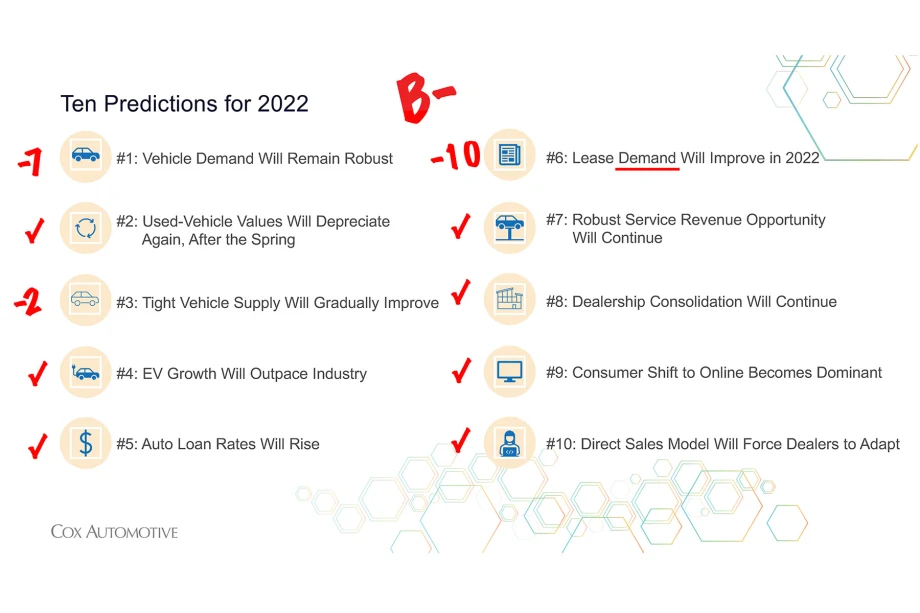
COX AUTOMOTIVE – As we did at the end of the second quarter, our team took a look back at the market predictions we posted in January. This quarterly review is helpful, as it allows us to see how the market has progressed compared to expectations. Forecasting is a tough business, especially in a year with so many changing market dynamics, but many of our initial predictions have held up reasonably well. As was the case at the end of last quarter, we have fallen short in three areas.
1. We predicted vehicle demand would remain robust in 2022 but sales year to date are well off last year’s pace. Total retail sales did not improve in Q3. The third quarter saw the bite of higher rates, particularly in the used-vehicle market. Stubborn inflation has been the headline this year, and the Federal Reserve has moved aggressively to tackle it. We fully expected interest rates to increase in 2022 – as noted in prediction #5 – but the size and rate of the increases have surprised even us.The Fed is aggressively moving to reduce demand, and that’s exactly what the Fed is getting. Higher interest rates have already impacted the housing market, and the auto industry is now feeling that pain as well. We are seeing softening prices, increasing inventory levels, and indications that buyers, particularly those with subprime credit ratings, are falling out of the market. Demand for new and used vehicles is no longer robust. As they say, you can’t fight the Fed. Our #1 prediction was wrong. Points off.
2. We again fully acknowledge that our initial expectation of improving vehicle inventory in 2022 has not materialized as we had thought it would. Yes, used-vehicle inventory is notably higher than in 2021 and, generally, is back above historic norms. New-vehicle inventory, however, remains stubbornly tight. Slower sales and some production improvements are helping, and new-vehicle inventory volume at the end of Q3 is up 40% from the same period in 2021. Even U.S. auto dealers are indicating that inventory is improving. But both new-vehicle inventory volume and days’ supply remain far below historic norms, so we can’t take full points on this prediction, but our score has improved since Q2.
3. Points have to be taken away for expecting leasing demand to improve in 2022. We do think the demand is there, but we can’t take credit for lease demand when lease penetration has fallen further. In this tight-inventory market, automakers are not pushing lease deals, and overall new-vehicle demand is showing signs of waning. In 2019, leasing accounted for roughly 30% of the retail market. In 2022, thanks to a number of factors, leasing will likely account for closer to 20% of retail, well below historic norms. We do believe leasing share will improve at some point, but that is not the case in 2022. On this topic we take all the points away.
Click here to read the full report.
Originally posted on F&I and Showroom
More Industry

Charger Network Growth Slows
Despite a projected increase in public EV chargers in 2026, charging infrastructure remains a top concern for consumers as the gap between the most and least EV-friendly places remains substantial.
Read More →
Lenders, Consumers Take on More Auto Loan Risk
September records loosened credit access the most in over a decade as buyers took advantage of the conditions to afford trading, though loan applications fell.
Read More →
Next-Gen Hybrids in Sight
Dealerships can expect to see revamped hybrids from Honda next year as the company rolls out a new system and model lineup.
Read More →
Gem State Stores Change Hands
A larger auto group founded in the industry’s early years sold two franchises to a neighbor group that's on a growth spurt.
Read More →
Charging In Motion
Honda has been researching wireless in-motion charging for electric vehicles since 2025, and new technology developments have put it a step closer to a final product.
Read More →
Twin Cities Stores Sell
Minnesota-based Walser Automotive Group made what it called the most significant acquisition in its history with a three-rooftop deal in Minneapolis.
Read More →
U.S. Auto Sales Still Below Prepandemic Levels
Mobility Global industry observers don’t expect the market to return to the higher volumes that became routine before Covid but to stay well below its potential.
Read More →
The Powertrain Shift
Electric-vehicle owners are backpedaling, according to new data, with product availability driving many to shift back to gas-powered engines.
Read More →
Achromatic Autos
The shades that dominate the U.S. car market don’t call attention to themselves, though grayscale may have plateaued after a 30-year upswing, research shows.
Read More →
Used-Vehicle Affordability Worsens
Listing prices in August defied seasonal trends, rising above $27,000 for the second time this year.
Read More →