Porsche and GMC rank highest in respective segments.
5 min to read
TROY, Mich. – From coast to coast, new vehicles are hard to find on dealership lots as the supply chain disruption and effects of the pandemic continue. However, customer satisfaction with the vehicle purchase experience holds steady year over year, according to the J.D. Power 2021 Sales Satisfaction Index (SSI) Study, SM released today. Overall sales satisfaction remains at 789 points (on a 1,000-point scale). Satisfaction among dealers where buyers purchased their vehicle increases 2 points to 841, while satisfaction with rejected dealers declines 6 points to 632.
The buyer satisfaction increase is buoyed by buyers receiving more money for their trade-in than they expected at the time of new-vehicle purchase. Year over year, the percentage of buyers who got more than they expected for their trade-in increases nine percentage points in the mass market segment and increases eight percentage points in the premium segment. However, satisfaction among vehicle buyers significantly decreased year over year in the inventory-related factors for website (-14 points) and at the dealership facility (-16 points).
Ad Loading...
“Despite the lack of inventory, dealerships have overcome what might be thought of as a challenging sales environment for shoppers,” said Chris Sutton, vice president of automotive retail at J.D. Power. “Right now, it’s hard to see the light at the end of the supply chain tunnel, so dealerships need to continue to sell vehicles through their inbound pipeline and help customers with special orders. However, the silver lining for customers is that trade-in values remain high and this has had a positive effect on customer sales satisfaction.”
The study also finds that satisfaction with the variety of dealership inventory significantly decreased 0.55 points (on a 10-point scale) among mass market shoppers and 0.42 points among premium shoppers during a three-month period from March through May 2021.
Following are key findings of the 2021 study:
If you build new vehicles, buyers will come: Manufacturers struggling most with inventory shortages are losing shoppers to competitors. The percentage of shoppers rejecting a brand due to inventory shortages is most prevalent among domestic truck brands—Ram (37%); GMC (36%); Chevrolet (35%); and Dodge (33%). Genesis has the highest percentage of rejecters (39%) among all brands because dealerships didn’t have the exact vehicle they wanted, which is 14 percentage points above the industry average of 25%. “The good news for dealers is that 78% of rejecters who reject a dealership due to inventory shortages indicate they will consider the dealership for future vehicle purchases. In other words, they’re not blaming the retailer for an inability to find their new vehicle,” Sutton said.
Buyers of new battery-electric vehicles less satisfied with sales experience: There is a large disparity in satisfaction among buyers of battery-electric vehicles (BEVs) and buyers of internal combustion engine (ICE) vehicles. The overall buyer satisfaction index is 54 points lower for BEVs (790) than for traditional gasoline-powered vehicles (844). A cause for this is dealership personnel vehicle knowledge/expertise, with more than a full point difference in sales satisfaction between BEV buyers (7.59 on a 10-point scale) and gasoline buyers (8.72). “BEV buyers are a unique challenge for dealers,” Sutton said. “As manufacturers ready new model launches, now is the time to ramp up training and knowledge of BEVs and related services—such as charging and aftersales requirements—as buyers will undoubtedly have more questions about them.”
Remote buyers more satisfied with digital retailing: The study finds that, among those buyers who are willing and able to purchase their vehicle without having to physically visit their selling dealer, satisfaction is much higher in both the premium and mass market segments than among those buyers who go to the dealership. “The ‘Amazon effect’ of seeing, buying and having a product delivered to your doorstep has made its way into vehicle buying and it is here to stay,” Sutton said.
Tesla’s unofficial score improves from 2020: Tesla receives an SSI score of 815, an increase from its unofficial score of 804 a year ago. The automaker is not officially ranked among other brands in the study because it doesn’t meet ranking criteria. Unlike other manufacturers, Tesla doesn’t grant J.D. Power permission to survey its owners in 15 states where it is required. However, Tesla’s score was calculated based on a sample of surveys from owners in the other 35 states.
Study Rankings
Ad Loading...
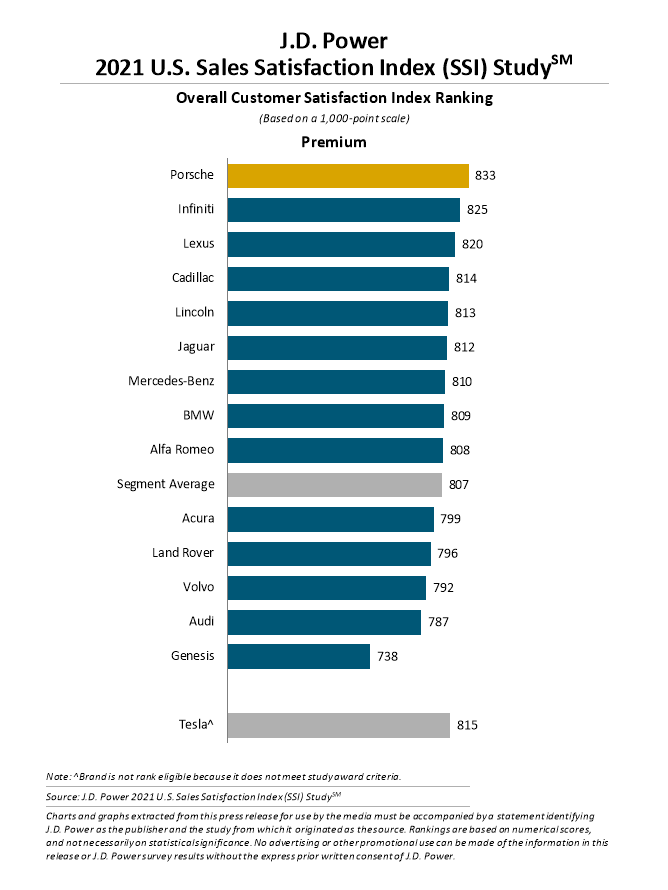
Porsche ranks highest in satisfaction with dealer service among premium brands with a score of 833. Infiniti(825) ranks second, followed by Lexus (820), Cadillac (814) and Lincoln (813).
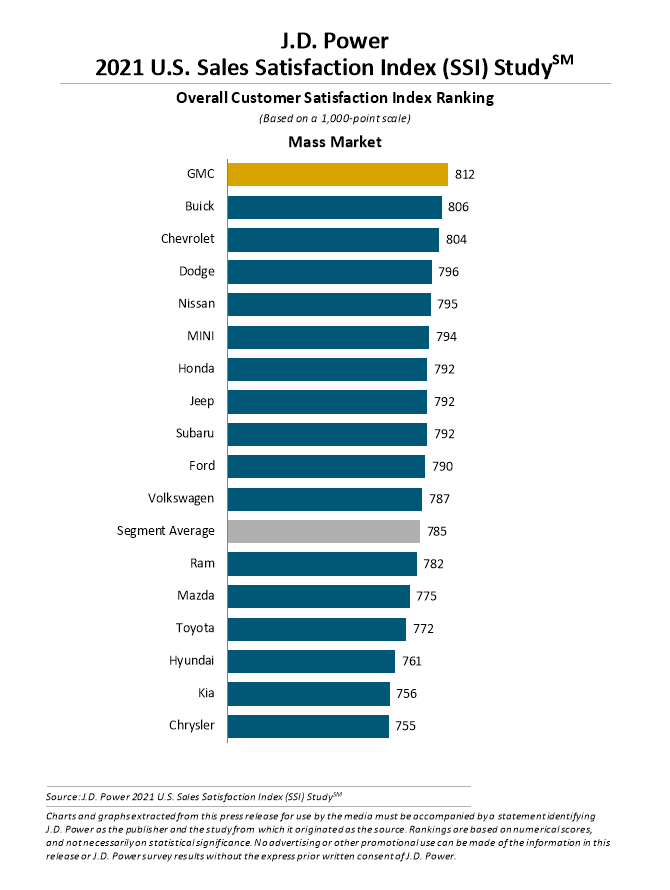
GMC ranks highest in satisfaction with dealer service among mass market brands, with a score of 812. Buick (806) ranks second, followed by Chevrolet (804), Dodge (796) and Nissan (795).
Brands showing the greatest improvement in satisfaction scores year over year are Jeep (+24), Chevrolet (+17) and Dodge (+17).
Now in its 36th year, the U.S. Sales Satisfaction Index (SSI) Study measures satisfaction with the sales experience among new-vehicle buyers and rejecters (those who shop a dealership and purchase elsewhere). Buyer satisfaction is based on six factors (in order of importance): delivery process (28%); dealer personnel (21%); working out the deal (19%); paperwork completion (19%); dealership facility (10%); and dealership website (4%). Rejecter satisfaction is based on five factors: salesperson (40%); price (23%); facility (15%); variety of inventory (12%); and negotiation (10%).
The 2021 U.S. Sales Satisfaction Index (SSI) Study is based on responses from 35,387 buyers who purchased or leased their new vehicle from March through May 2021. The study is a comprehensive analysis of the new-vehicle purchase experience and measures customer satisfaction with the selling dealer (satisfaction among buyers). The study also measures satisfaction with brands and dealerships that were shopped but ultimately rejected in favor of the selling dealership (satisfaction among rejecters). The study was fielded from July through September 2021.
For more information about the U.S. Sales Satisfaction Index (SSI) Study, visit https://www.jdpower.com/business/automotive/us-sales-satisfaction-index-ssi-study.
Trade relations between the European Union and the U.S. are at risk, causing the European Automobile Manufacturers Association to push lawmakers to make a decision.
China easily reigns in the segment, but European countries’ adoption rates are growing. The U.S., probably due to market size, has the second biggest EV fleet.
Fast charging of electric vehicles provides a solution for range anxiety, but it also poses a risk to battery cycle life due to increased temperatures, according to an EV supply chain data provider.
The automaker says its movement of some electric-vehicle work to the S.C. factory is part of a more tailored product focus. It also plans to add a new hybrid model to the plant’s itinerary.