


EVs Pummel Today’s Road Guardrails
Crash tests show today’s barriers are no match for the heavier vehicles.

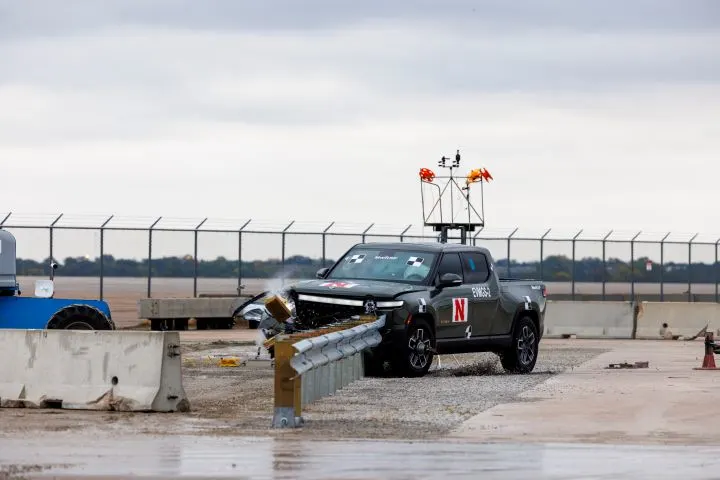
Today's guardrails were designed for lighter vehicles, but EVs are significantly heavier than gas-powered models.
IMAGE: Midwest Roadside Safety Facility
Today’s roadway guardrails don’t appear to be sturdy enough for electric vehicles, according to recent crash tests.
Commissioned by the U.S. Army Corps of Engineers to determine whether guardrails and military barriers can handle “hostile” EVs, the tests were conducted last fall by the Midwest Roadside Safety Facility at the University of Nebraska-Lincoln.
The facility used a 2018 Tesla Model 3 sedan and a 2022 Rivian R1T pickup in the 60-mph crash tests. It said the Tesla lifted the guardrail upon impact and passed underneath it, and the truck tore through it with little loss of speed.
The guardrail was designed for lighter vehicles of up to 5,000 pounds, but EVs are significantly heavier than gas-powered vehicles and can therefore do more damage, having 20% to 50% more energy upon impact, the facility said in a press release on the crash test findings.
The Corps of Engineers wanted to determine whether the proliferation of EVs could break through national safety defenses. It plans more such tests.
Beyond potential hostile vehicle operators who might compromise national security, there is the issue of general public traffic safety. The testing center said there are more than 100,000 off-road crashes in the U.S. each year that lead to thousands of deaths.
“It is going to be necessary to re-examine the designs of roadside barriers even beyond the EVs,” said Cody Stolle, the facility’s assistant director. “It’s a critical and timely need.”
The university, which has led past roadside barrier design projects, will work on a new design to accommodate EVs.
Originally posted on Auto Dealer Today
More Industry

Charger Network Growth Slows
Despite a projected increase in public EV chargers in 2026, charging infrastructure remains a top concern for consumers as the gap between the most and least EV-friendly places remains substantial.
Read More →
Lenders, Consumers Take on More Auto Loan Risk
September records loosened credit access the most in over a decade as buyers took advantage of the conditions to afford trading, though loan applications fell.
Read More →
Next-Gen Hybrids in Sight
Dealerships can expect to see revamped hybrids from Honda next year as the company rolls out a new system and model lineup.
Read More →
Gem State Stores Change Hands
A larger auto group founded in the industry’s early years sold two franchises to a neighbor group that's on a growth spurt.
Read More →
Charging In Motion
Honda has been researching wireless in-motion charging for electric vehicles since 2025, and new technology developments have put it a step closer to a final product.
Read More →
Twin Cities Stores Sell
Minnesota-based Walser Automotive Group made what it called the most significant acquisition in its history with a three-rooftop deal in Minneapolis.
Read More →
U.S. Auto Sales Still Below Prepandemic Levels
Mobility Global industry observers don’t expect the market to return to the higher volumes that became routine before Covid but to stay well below its potential.
Read More →
The Powertrain Shift
Electric-vehicle owners are backpedaling, according to new data, with product availability driving many to shift back to gas-powered engines.
Read More →
Achromatic Autos
The shades that dominate the U.S. car market don’t call attention to themselves, though grayscale may have plateaued after a 30-year upswing, research shows.
Read More →
Used-Vehicle Affordability Worsens
Listing prices in August defied seasonal trends, rising above $27,000 for the second time this year.
Read More →