


Quality, Styling Distinguish Top EV Models, J.D. Power Finds
But its study shows public charging woes continue to be felt among consumers.

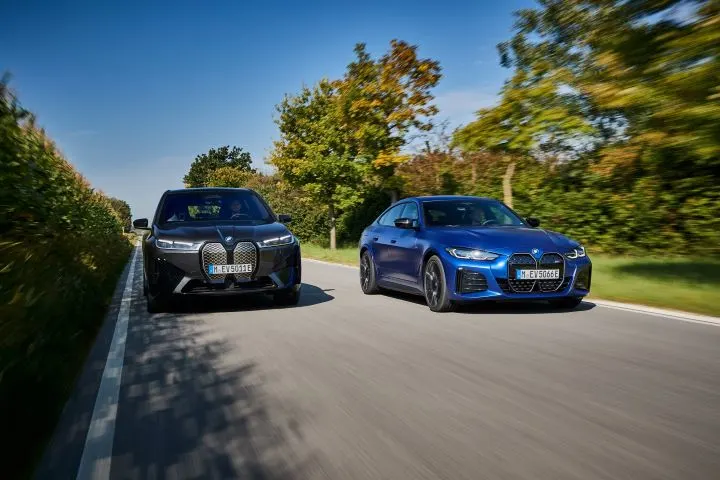
The BMW i4 outranked all others in the EV study.
IMAGE: BMW
As more car buyers make the switch to battery-electric vehicles, traditional factors that are also important to buyers of gas-powered vehicles are becoming critical to satisfaction among BEV owners. Quality and cost of ownership have emerged as top factors influencing satisfaction, according to the newly released J.D. Power 2024 U.S. Electric Vehicle Experience Ownership Study, which also reveals that public charger availability not only remains the least satisfying aspect of owning a BEV but also that the experience has become notably worse.
The BMW i4 ranks highest overall and among premium BEVs, while the MINI Cooper Electric is the highest-ranking mass market BEV for a second consecutive year. Both models rank highest in their respective segment on the strength of their performance in the vehicle quality and reliability factor. Each model scores more than 60 points on a 1,000-point scale, higher than their respective nearest segment competitors for that factor.
“The increase in the EV share of the new-vehicle market, reflected by seven new rank-eligible models this year, is a notable step in the transition toward vehicle electrification,” said Brent Gruber, executive director of the EV practice at J.D. Power. "Many products are hitting the mark and resonating with shoppers but, at the same time, the decline in satisfaction with public charging availability should serve as a warning because concern about access to public charging is a key reason many buyers currently reject BEVs. For EVs to reach their full potential, this issue needs to be resolved."
Following are key findings of the 2024 study:
Publicchargingisn’tjustbad—it’sgettingworse: The study finds that the public charging experience continues to be a major source of EV owner frustration. Further, non-Tesla owners indicate that the situation is deteriorating. Among mass-market BEV owners, satisfaction with public charger availability is 32 points lower than a year ago. “The industry should view this lack of improvement as a critical issue that requires decisive action,” Gruber said.
Mass market BEVs deliver higher quality than premium BEVs: Owners of mass-market brand BEVs experience fewer problems with their vehicles than do owners of premium BEVs. Eleven of the 14 ranked mass-market models outperform the premium brand market average in total problems. “Quality and reliability are the most important drivers of a positive EV ownership experience,” Gruber said. “As EVs extend to the broader market, minimizing problems will be key to meeting consumer expectations.”
First-time BEV owners are less satisfied than BEV veterans: Buyers new to BEV ownership are less satisfied than those who have previously owned a BEV. This year, the satisfaction gap between the two groups is 28 points, whereas a year ago, the gap was 14 points. Overall satisfaction among first-time BEV owners has declined 16 points from 2023. Battery range and public charging availability are the two factors in which the gap between previous BEV owners and new owners is greatest.
Most BEV owners say they’ll consider a BEV again, but first-time BEV owners may be more fickle: First-time BEV owners say they are open to considering non-BEVs in the future. However, almost half (48%) say they will consider a plug-in hybrid vehicle (PHEV) and 39% say they are willing to consider hybrid or internal combustion engine (ICE) vehicles. Meanwhile, 38% of previous BEV owners say they are willing to consider a PHEV and only 19% would consider a hybrid or ICE vehicle for their next purchase.
PHEVs might not present a good alternative to BEVs: Recently, news reports have suggested that plug-in hybrids could solve many of the issues plaguing BEVs, such as range limitations and lack of public charging availability. However, this year’s study finds that owners of PHEVs are, on the whole, much less satisfied with their vehicle than are owners of BEVs. Overall satisfaction with PHEVs is 629, while mass market BEVs (718) and premium BEVs (750) score much higher. “Plug-in hybrids may not be the simple solution to solving early issues with full battery electric vehicles,” Gruber said. “Expected lower running costs is a top purchase reason for EVs but satisfaction with the cost of ownership is much lower for plug-in hybrids. Plug-in hybrids retain the costs of maintaining a traditional powertrain yet without the benefit of the extended electric driving range found in full battery electric vehicles.”
Get all the details here.
Originally posted on Auto Dealer Today
More Industry

Charger Network Growth Slows
Despite a projected increase in public EV chargers in 2026, charging infrastructure remains a top concern for consumers as the gap between the most and least EV-friendly places remains substantial.
Read More →
Lenders, Consumers Take on More Auto Loan Risk
September records loosened credit access the most in over a decade as buyers took advantage of the conditions to afford trading, though loan applications fell.
Read More →
Next-Gen Hybrids in Sight
Dealerships can expect to see revamped hybrids from Honda next year as the company rolls out a new system and model lineup.
Read More →
Gem State Stores Change Hands
A larger auto group founded in the industry’s early years sold two franchises to a neighbor group that's on a growth spurt.
Read More →
Charging In Motion
Honda has been researching wireless in-motion charging for electric vehicles since 2025, and new technology developments have put it a step closer to a final product.
Read More →
Twin Cities Stores Sell
Minnesota-based Walser Automotive Group made what it called the most significant acquisition in its history with a three-rooftop deal in Minneapolis.
Read More →
U.S. Auto Sales Still Below Prepandemic Levels
Mobility Global industry observers don’t expect the market to return to the higher volumes that became routine before Covid but to stay well below its potential.
Read More →
The Powertrain Shift
Electric-vehicle owners are backpedaling, according to new data, with product availability driving many to shift back to gas-powered engines.
Read More →
Achromatic Autos
The shades that dominate the U.S. car market don’t call attention to themselves, though grayscale may have plateaued after a 30-year upswing, research shows.
Read More →
Used-Vehicle Affordability Worsens
Listing prices in August defied seasonal trends, rising above $27,000 for the second time this year.
Read More →