


Recent Vintage Loans Perform Well Even as More Non-Prime Consumers Secured Credit in Second Half of 2021
With consumer credit performance maintaining healthy levels across auto, credit card, personal loans and mortgages, lenders continued to ramp up new account origination growth in the non-prime segment of the market near the end of 2021.


With consumer credit performance maintaining healthy levels across auto, credit card, personal loans and mortgages, lenders continued to ramp up new account origination growth in the non-prime segment of the market near the end of 2021.
TRANSUNION –With consumer credit performance maintaining healthy levels across auto, credit card, personal loans and mortgages, lenders continued to ramp up new account origination growth in the non-prime segment of the market near the end of 2021. TransUnion’s (NYSE: TRU) newly released Q4 2021 Quarterly Credit Industry Insights Report (CIIR) also found that loans to non-prime borrowers increased while accounts originated during the pandemic in 2020 continued to perform as well or better when compared to loans from previous years.
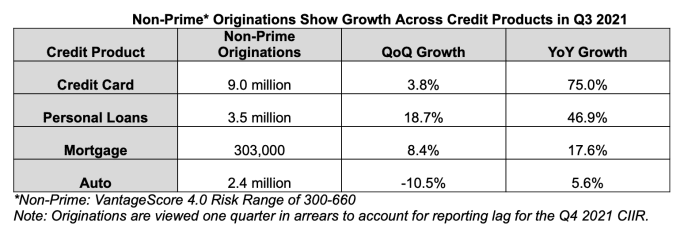
The credit card market, in particular, saw a very high rate of new account growth in Q3 2021 (latest data available) with a record 20.1 million originations, 9.0 million of which were to non-prime consumers. Overall card originations in the quarter grew 63% year-over-year, while non-prime originations increased 75% YoY from the 5.1 million non-prime originations that occurred in Q3 2020. The non-prime risk range includes the subprime risk tier (defined as a VantageScore 4.0 range of 300-600) as well as the near prime risk tier (score range of 600-660).
“There was a great deal of uncertainty in the initial months of the pandemic, and many lenders opted to take a wait and see approach. Adding to the uncertainty was the jump in consumers in loan accommodation programs, and questions on how those consumers would perform once they exited those programs. Lending to below prime consumers was suppressed and financial institutions turned their focus to the prime areas of the market to help mitigate risk,” said Charlie Wise, senior vice president of research and consulting at TransUnion. “Toward the end of 2021, the majority of accommodation programs have expired and lenders have seen that consumers continue to perform well on their credit obligations. Lenders are eager to pursue growth, including expanding back into the non-prime consumer segment.”
Supply issues have impacted sales volume in the auto industry and consequently, auto originations have stayed relatively flat. However, overall originations were buoyed by the below prime segment – which grew from 2.3 million in Q3 2020 to 2.4 million in Q3 2021. The mortgage industry, on the other hand, saw explosive growth throughout the pandemic with high levels of originations several quarters in a row due to the low interest rate environment. While non-prime consumers account for a fraction of all originations, the non-prime risk segment has also seen recent growth, with an increase of 17.6% YoY in Q3 2021, despite overall originations falling -12.6% in that same period.
Despite recent upticks in delinquencies in the most recent quarter, serious delinquency rates also remained near or below pre-pandemic levels in the wake of expired forbearance programs, which has continued to restore lender confidence. Borrower-level 60+ days past due (DPD) delinquencies for personal loans saw a seasonal uptick in Q4 2021 to 3.00%, but still remains well below the 3.48% observed in Q4 2019. The borrower-level 90+DPD for credit card reflects a similar trend and reached 1.48% in Q4 2021, but remains well below the 2.19% delinquency rate in Q4 2019.
TransUnion also looked at the 12-month performance of loans originated in 2020 compared to earlier years to better gauge consumer credit health. All credit products either outperformed or had similar performance compared to accounts opened in 2018 and 2019.
“As the economy continues to recover and consumer credit health remains strong, lenders will likely continue to extend access to credit across the risk spectrum, including non-prime consumers, and origination volumes are expected to grow. Credit growth is also likely to be bolstered as consumers return to credit markets in the wake of government stimulus programs during the pandemic, which injected excess liquidity into the consumer wallets. As this excess liquidity wanes, we expect to see consumer credit demand return to more normal patterns,” added Wise.
For more information about the report, please register for the Q4 2021 Quarterly Credit Industry Insights Report Webinar.
Originally posted on Agent Entrepreneur
More Industry

Charger Network Growth Slows
Despite a projected increase in public EV chargers in 2026, charging infrastructure remains a top concern for consumers as the gap between the most and least EV-friendly places remains substantial.
Read More →
Lenders, Consumers Take on More Auto Loan Risk
September records loosened credit access the most in over a decade as buyers took advantage of the conditions to afford trading, though loan applications fell.
Read More →
Next-Gen Hybrids in Sight
Dealerships can expect to see revamped hybrids from Honda next year as the company rolls out a new system and model lineup.
Read More →
Gem State Stores Change Hands
A larger auto group founded in the industry’s early years sold two franchises to a neighbor group that's on a growth spurt.
Read More →
Charging In Motion
Honda has been researching wireless in-motion charging for electric vehicles since 2025, and new technology developments have put it a step closer to a final product.
Read More →
Twin Cities Stores Sell
Minnesota-based Walser Automotive Group made what it called the most significant acquisition in its history with a three-rooftop deal in Minneapolis.
Read More →
U.S. Auto Sales Still Below Prepandemic Levels
Mobility Global industry observers don’t expect the market to return to the higher volumes that became routine before Covid but to stay well below its potential.
Read More →
The Powertrain Shift
Electric-vehicle owners are backpedaling, according to new data, with product availability driving many to shift back to gas-powered engines.
Read More →
Achromatic Autos
The shades that dominate the U.S. car market don’t call attention to themselves, though grayscale may have plateaued after a 30-year upswing, research shows.
Read More →
Used-Vehicle Affordability Worsens
Listing prices in August defied seasonal trends, rising above $27,000 for the second time this year.
Read More →