


Toyota and Honda Neck in Neck in WRI Study
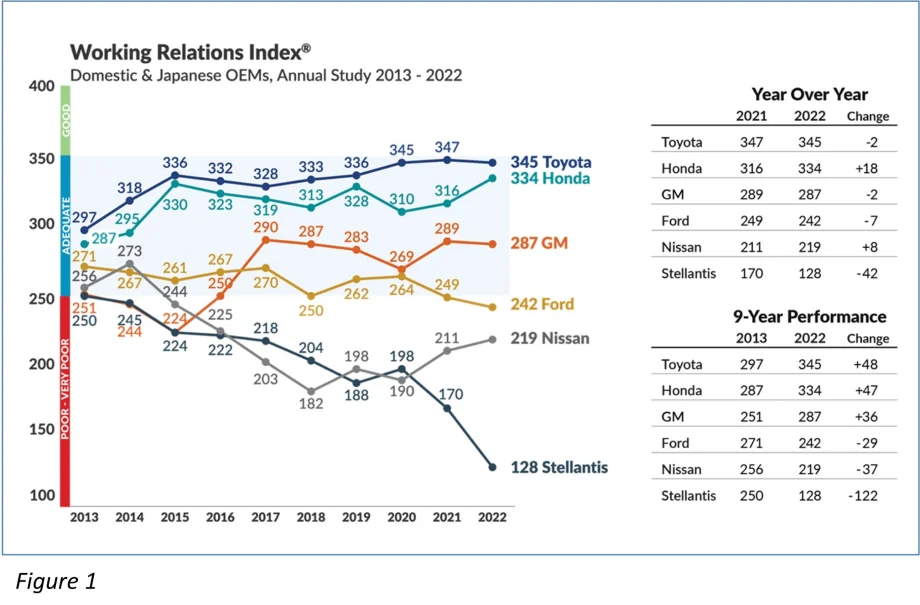
The 2022 Working Relations Index shows Toyota in first place, with Honda rapidly closing in.

Plante Moran
Plante Moran has released results of the 22nd annual North American Automotive OEM - Supplier Working Relations Index® (WRI®) Study.
The study shows supply chain shortages and production volatility, the transition toward electric vehicles, logistics constraints, and increasing raw material costs impacting automakers and suppliers has had the impact one might think. In fact, two of the six major U.S. OEMs made substantial improvement in their WRI® scores and two held steady, while two others fell – one significantly.
The 2022 Working Relations Index shows Toyota in first place, with Honda moving up. GM remains in third place at 287, with Ford fell further behind at 242. Nissan is in fifth place, continuing major gains started in 2020, with another big move up this year. Stellantis is in last place, having fallen 70 points since 2020.
Honda ranks No. 1 in purchasing organization effectiveness, claiming the top spot in six out of seven categories.
The study also ranks supplier trust of the OEM and buyer integrity. Trust represents the foundation of overall working relations and is a major factor that drives the Working Relations Index ranking. Supplier trust of the buyer is also key. Here, Stellantis and Ford fell in Supplier Trust, and Stellantis, Ford and GM fell in Buyer Integrity.
The index also ranks buyers on key attributes such as the buyer’s knowledge of the supplier’s products or technology, communication, and overall characteristics including integrity and trust. Here, Honda took the top spot passing Toyota, while GM ranked a close third. Ford and Stellantis dropped significantly, but Nissan improved.
Overall, Honda ranked best in three categories, taking two from Toyota. Together, the two automakers dominated all top spots in the Purchasing Area rankings.
The overall Working Relations Index is based on Business Practices and Buyer Characteristics. The SBI, or Supplier Benefits Index, ranks the type and degree of support the OEM receives as a result of good working relations. Toyota ranked in first place on the overall Working Relations Index and also derives the greatest supplier support.
Still Toyota dropped 2 points to 345, while Honda gained 18 points and rose to 334, narrowing the gap between first and second to 11 points. GM fell 2 points to 287 and Ford fell 7 points to 242. Nissan improved 8 points to 219, while Stellantis dropped 42 points to 128.
Honda and Nissan improved the most. The spread from highest (Toyota 345) to lowest (Stellantis 128) was 217 points, the greatest since the 2008 spread of 206 between the same two automakers.
The key to mutual success in OEM-supplier relations is trust, said Andrea, and trust is based on three factors: setting realistic expectations; delivering on commitments; and sharing information.
Trust goes both ways, Dave Andrea, Principal in Plante Moran's Strategy and Automotive & Mobility Consulting Practice, which conducts the annual study, told PR Newswire. "Companies get out what they put in. In the new world of scarce resources with numerous customer opportunities, the supplier has to ask himself: who would I rather do business with, my customer of choice? And the answer comes down to three questions: Who do I trust? Where will I get the best return on investment? And what is the prospect for future business? The OEMs are equally dependent on suppliers they can trust."
He adds, "The OEMs really need to focus on more transparency and better communication. They need to better align purchasing, engineering, and manufacturing to achieve the same goals – improved communication, efficiency and speed – in order to take cost and time out of the entire supply chain while helping suppliers achieve their cost and financial performance goals as well. These processes must become more agile and streamlined to benefit both the OEM and supplier. If done property, it's win-win, and setting realistic goals, fulfilling commitments, and sharing information openly and honestly doesn't cost any money."
Andrea also listed areas of on-going concern to suppliers that could be resolved if given priority and if resolved would greatly benefit both suppliers and the automakers. They include:
Eliminating lengthy delays on piece part and tooling price disputes.
Handling volatile production schedules.
Sharing price and other market risks.
Developing bench strength.
Recognizing supplier relations is everyone's responsibility.
"All of these typical problems can be resolved," said Andrea. "Look how fast and successfully automakers switched to the production of COVID face masks and respirators. When there's corporate commitment, things get done – fast. These are not complicated issues. And if resolved, the automakers will be more profitable, improve vehicle launches, reduce warranty claims and recalls, and better positioned to transition to EVs."
Originally posted on Auto Dealer Today
More Industry

Charger Network Growth Slows
Despite a projected increase in public EV chargers in 2026, charging infrastructure remains a top concern for consumers as the gap between the most and least EV-friendly places remains substantial.
Read More →
Lenders, Consumers Take on More Auto Loan Risk
September records loosened credit access the most in over a decade as buyers took advantage of the conditions to afford trading, though loan applications fell.
Read More →
Next-Gen Hybrids in Sight
Dealerships can expect to see revamped hybrids from Honda next year as the company rolls out a new system and model lineup.
Read More →
Gem State Stores Change Hands
A larger auto group founded in the industry’s early years sold two franchises to a neighbor group that's on a growth spurt.
Read More →
Charging In Motion
Honda has been researching wireless in-motion charging for electric vehicles since 2025, and new technology developments have put it a step closer to a final product.
Read More →
Twin Cities Stores Sell
Minnesota-based Walser Automotive Group made what it called the most significant acquisition in its history with a three-rooftop deal in Minneapolis.
Read More →
U.S. Auto Sales Still Below Prepandemic Levels
Mobility Global industry observers don’t expect the market to return to the higher volumes that became routine before Covid but to stay well below its potential.
Read More →
The Powertrain Shift
Electric-vehicle owners are backpedaling, according to new data, with product availability driving many to shift back to gas-powered engines.
Read More →
Achromatic Autos
The shades that dominate the U.S. car market don’t call attention to themselves, though grayscale may have plateaued after a 30-year upswing, research shows.
Read More →
Used-Vehicle Affordability Worsens
Listing prices in August defied seasonal trends, rising above $27,000 for the second time this year.
Read More →