


Black Book: Weekly Market Update
With the large declines in the market, buyers are being more hesitant to pay any extra money for inventory.

Wholesale Prices, Week Ending August 19
The wholesale market continued to experience record declines for a third consecutive week, prices in some mainstream segments decreasing by more than 2%. On the other hand, we have yet to see any meaningful decrease in used-retail listed prices.
This Week Last Week 2017-2019 Average (Same Week)
Car segments -1.73% -1.35% -0.19%
Truck & SUV segments -1.43% -1.49% -0.21%
Market -1.52% -1.45% -0.21%
Car Segments
On a volume-weighted basis, the overall car segment decreased 1.73%. For reference, in the previous week, cars decreased by 1.35%. The decline exceeds the largest single-week depreciation experienced at the onset of the pandemic of 1.40%.
The 0- to 2-year-old car segments were down 1.20%, and 8- to 16-year-old cars declined 1.90%.
All nine car segments decreased, seven reporting declines exceeding 1%.
Compact (-2.51%), midsize (-2.16%), and full size (-2.15%) cars declined more than 2%, the third straight week of single-week depreciation exceeding 2% in the segment.
Premium sporty and prestige luxury continue to experience typical seasonal depreciation.
Truck / SUV Segments
The volume-weighted overall truck segment decreased 1.43%, which is consistent with depreciation the prior week, of 1.49%.
The 0- to 2-year-old models declined 1.20%, while the 8- to 16-year-olds declined 1.10%.
All 13 truck segments declined, and 11 had declines greater than 1%.
Minivan (-2.15%) was the only truck segment to drop by more than 2%. Despite being a large decline, it's still less than some of the declines last year and at the onset of the pandemic that were as large as 2.50%.
The small pickup (-0.74%) segment had smaller depreciation than the larger full-size pickup segment (-1.34%).
Weekly Wholesale Index
The graphic below looks at trends in wholesale prices of 2- to 6-year-old vehicles indexed to the first week of the year. The index is computed keeping the average age of the mix constant to identify market movements.
Used Retail Prices
Used-retail prices are more accessible than in years pas due to the proliferation of no-haggle pricing for used-vehicle retailing. Transparent pricing upfront makes the car-buying process more enjoyable for customers and allows Black Book to accurately measure retail market trends.
At the onset of the pandemic, in CY2020, used-retail prices increased slightly, following typical seasonal patterns, then began dropping in April, finally hitting a low point in the late spring months. By late summer of CY2020, they increased as supply of new-vehicle inventory started to become scarce, but retail demand slowed at the end of CY2020, resulting in declining retail asking prices for the last several weeks of the year. When CY2021 kicked off, demand rebounded while retail prices lagged slightly behind wholesale prices; March 2021 started the dramatic increases in prices, fueled by stimulus payments, tax season and shortages of new inventory. During the third quarter, retail prices continued to rise at a slower rate but soon picked up again to start the fourth quarter, when they steadily increased. As CY2021 came to an end, the retail listing price index closed 36% above where the year began, then remained relatively stagnant through most of CY2022. In the fourth quarter, the Retail Listings Price Index started to decline but not as steeply as the wholesale price index.
This analysis is based on approximately two million vehicles listed for sale on U.S. dealer lots. The graphic below looks at 2- to 6-year-old vehicles. The index is computed keeping the average age of the mix constant to identify market movements.
Inventory
Used Retail
The Used Retail Active Listing Volume Index currently sits at 1.02 points.
The used retail days-to-turn estimate is currently hovering above 51.
Wholesale
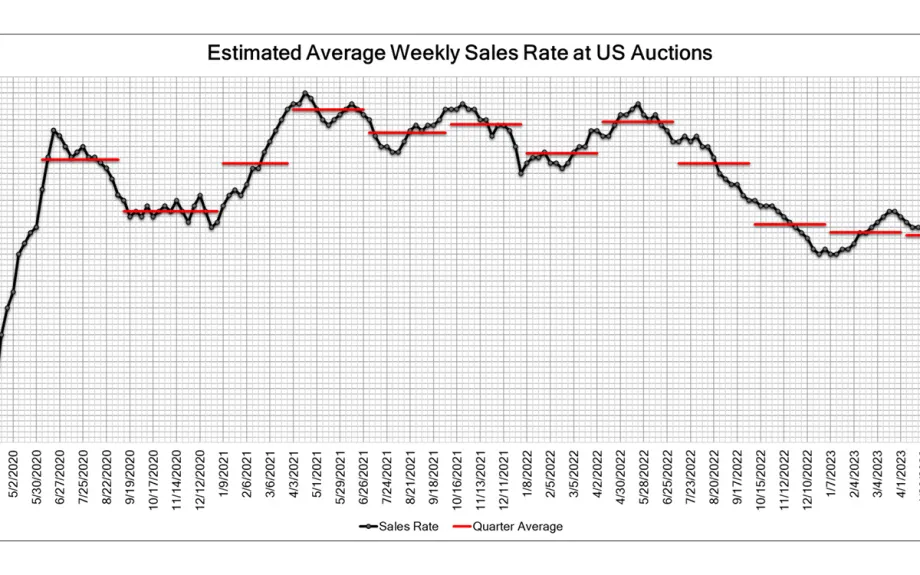
For the third week in a row, the market had steep declines in both the car and truck segments. Auction conversion rates declined 1% after the prior two weeks showed improvement in the market. With the large declines in the market, we are now seeing buyers being more hesitant to pay any extra money for inventory. Buyers and sellers are both in a wait-and-see mode.
As always, the Black Book team of analysts will keep their eyes on the market, watching for developing trends and insights.
The estimated Average Weekly Sales Rate declined to 49%.
Originally posted on Auto Dealer Today
More Industry

Charger Network Growth Slows
Despite a projected increase in public EV chargers in 2026, charging infrastructure remains a top concern for consumers as the gap between the most and least EV-friendly places remains substantial.
Read More →
Lenders, Consumers Take on More Auto Loan Risk
September records loosened credit access the most in over a decade as buyers took advantage of the conditions to afford trading, though loan applications fell.
Read More →
Next-Gen Hybrids in Sight
Dealerships can expect to see revamped hybrids from Honda next year as the company rolls out a new system and model lineup.
Read More →
Gem State Stores Change Hands
A larger auto group founded in the industry’s early years sold two franchises to a neighbor group that's on a growth spurt.
Read More →
Charging In Motion
Honda has been researching wireless in-motion charging for electric vehicles since 2025, and new technology developments have put it a step closer to a final product.
Read More →
Twin Cities Stores Sell
Minnesota-based Walser Automotive Group made what it called the most significant acquisition in its history with a three-rooftop deal in Minneapolis.
Read More →
U.S. Auto Sales Still Below Prepandemic Levels
Mobility Global industry observers don’t expect the market to return to the higher volumes that became routine before Covid but to stay well below its potential.
Read More →
The Powertrain Shift
Electric-vehicle owners are backpedaling, according to new data, with product availability driving many to shift back to gas-powered engines.
Read More →
Achromatic Autos
The shades that dominate the U.S. car market don’t call attention to themselves, though grayscale may have plateaued after a 30-year upswing, research shows.
Read More →
Used-Vehicle Affordability Worsens
Listing prices in August defied seasonal trends, rising above $27,000 for the second time this year.
Read More →