


Calif. Dealers Get Warranty Rate Hike, 10-Year Upgrade Intervals, CCPA Exemption
California Gov. Gavin Newsom has signed AB 179, enacting new dealer protections against below-market warranty reimbursement rates and OEM-ordered facility upgrades. The bill also allows dealers to issue recall notices without violating new data privacy rules.

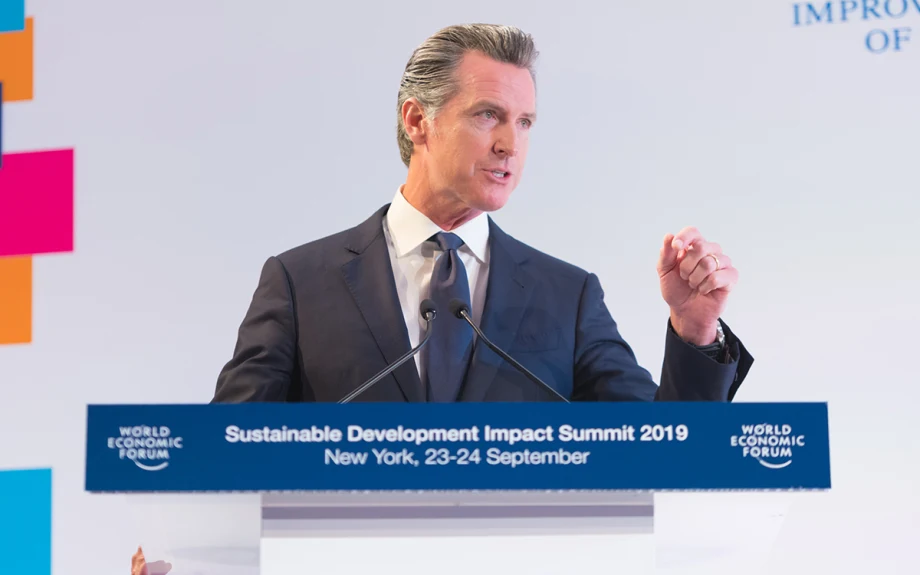
Calif. Gov. Gavin Newsom has signed a dealer protection bill similar to a measure vetoed by his predecessor a year ago.
Photo by World Economic Forum via Office of Governor Gavin Newsom
SACRAMENTO, Calif. — California Gov. Gavin Newsom signed Assembly Bill 179 on Saturday, making official an update to the state’s franchised dealer law. The bill affects retailers in three key areas: reimbursement for warranty work, facility upgrades ordered by manufacturers, and compliance with the California Consumer Privacy Act.
• Warranty reimbursement: Vehicle manufacturers must now pay California dealers a warranty parts and labor reimbursement rate closer to that charged to consumers. California New Car Dealers Association officials had lobbied forcefully for this change, noting a near-40% spread between the going rates and the passage of similar bills in other states.
• Facility upgrades: AB 179 forbids factories from ordering dealers to renovate showrooms and other facilities in intervals of less than 10 years.
• CCPA compliance: California dealers and their manufacturers are permitted to notify owners of vehicles subject to recall without violating the California Consumer Privacy Act. The state’s enhanced data privacy rules go into effect Jan. 1.
“This bill brings California’s new motor vehicle franchise laws into the 21st century.”
“This is a significant step forward in our commitment to a stronger and more equitable new motor vehicle franchise system for California new car dealers,” said CNCDA President Brian Maas. “With AB 179 taking effect Jan. 1, 2020, this is a huge victory for all Californians, local businesses, and consumers alike. This bill brings California’s new motor vehicle franchise laws into the 21st century by establishing a level playing field between local independently owned dealerships and multinational vehicle manufacturers.
“Franchise laws exist to govern the relationship between dealers and manufacturers,” Maas added. “California was overdue for significant improvements in the laws that will continue to protect dealers, their businesses, and their patrons. We are pleased and encouraged that Gov. Newsom agrees and supports our approach to improvements in California’s franchise laws.”
A similar dealer protection bill was unexpectedly vetoed by former Gov. Jerry Brown last year. AB 2107 included 10 provisions, including the normalization of warranty reimbursement rates and 15-year factory upgrade intervals.
Read: Calif. Governor Vetoes Dealer Protection Bill
At the time, Brown expressed concern over unspecified complications.
“Under current law, manufacturers are required to reimburse dealers for warranty and recall repairs at a ‘reasonable’ rate negotiated between the two parties,” Brown wrote in a statement. “This framework appears to be working reasonably well and I see no reason to adopt the rather complicated formula authorized in this bill — with perhaps unintended consequences.”
Just over a year later, his successor signed the new bill — one of 68 passed into law on Saturday alone, part of a flurry of signatures and vetoes that closed California’s 2019 legislative session.
“We have clearly achieved a great deal together, and I commend the legislature for their hard work,” Newsom said in a release. “I look forward to our continued partnership as we head into the new year and continue to tackle challenges of affordability and work to expand opportunity to all Californians.”
Originally posted on Auto Dealer Today
More Industry

Charger Network Growth Slows
Despite a projected increase in public EV chargers in 2026, charging infrastructure remains a top concern for consumers as the gap between the most and least EV-friendly places remains substantial.
Read More →
Lenders, Consumers Take on More Auto Loan Risk
September records loosened credit access the most in over a decade as buyers took advantage of the conditions to afford trading, though loan applications fell.
Read More →
Next-Gen Hybrids in Sight
Dealerships can expect to see revamped hybrids from Honda next year as the company rolls out a new system and model lineup.
Read More →
Gem State Stores Change Hands
A larger auto group founded in the industry’s early years sold two franchises to a neighbor group that's on a growth spurt.
Read More →
Charging In Motion
Honda has been researching wireless in-motion charging for electric vehicles since 2025, and new technology developments have put it a step closer to a final product.
Read More →
Twin Cities Stores Sell
Minnesota-based Walser Automotive Group made what it called the most significant acquisition in its history with a three-rooftop deal in Minneapolis.
Read More →
U.S. Auto Sales Still Below Prepandemic Levels
Mobility Global industry observers don’t expect the market to return to the higher volumes that became routine before Covid but to stay well below its potential.
Read More →
The Powertrain Shift
Electric-vehicle owners are backpedaling, according to new data, with product availability driving many to shift back to gas-powered engines.
Read More →
Achromatic Autos
The shades that dominate the U.S. car market don’t call attention to themselves, though grayscale may have plateaued after a 30-year upswing, research shows.
Read More →
Used-Vehicle Affordability Worsens
Listing prices in August defied seasonal trends, rising above $27,000 for the second time this year.
Read More →