


EV Demand Tepid
Consumer consideration flat amid passel of market drags.

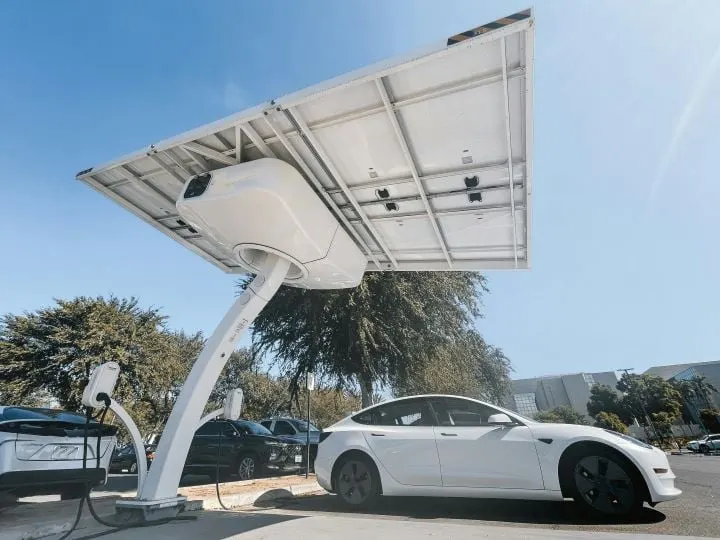
Teslas are losing market share amid an overall flattening of EV demand.
Kindel Media
U.S. electric-vehicle sales grew slowly in March amid a surge in shopping as consumers raced to buy before automotive tariffs took effect, but adoption plans were flat as federal support vanishes.
EV market share rose 1% year-over-year to 9%, J.D. Power reported, but the percentage of consumers in the market for a new car who are very likely to consider an EV was flat at 23%.
The consumer data analytics provider had forecast 9% EV market share this year, or flat results, given Trump administration plans to eliminate federal tax credits and its recent pullback of funding to states for EV charger development. Sparse charger availability, especially in rural areas, is consistently cited by consumers as a major adoption obstacle.
EV demand may also be tempered by recently enacted 25% U.S. tariffs on imported vehicles, along with planned matching tariffs on some auto parts to take effect May 3.
“While trends in demand are shifting geographically, socioeconomically and among individual brands, the industry continues to evolve,” J.D. Power said in its monthly EV market report, without elaborating.
Consumers considering EVs are more likely to be among those with annual incomes exceeding $100,000 and living in the West and Northeast states, J.D. Power said.
In a sign of political polarization, those affiliated as Republican saw a three percentage point drop in likelihood of considering an EV as their next vehicle, or 20% share. Consideration among Democratic consumers was essentially flat at 30%.
In a partially politically influenced trend, U.S. EV market leader Tesla is experiencing losing market share, though it was still tops among brands under consumer consideration at 18% of those somewhat or very likely to choose an EV, down from 21% a year earlier. Just one Tesla model was among the top 10 EVs being considered, the model 3.
Tesla CEO Elon Musk has drawn outrage in some quarters due to his leadership of federal spending and staff cuts. In addition, the Texas-based EV maker has seen declining market share for two years amid rising competition and an aging lineup, J.D. Power said.
Originally posted on Auto Dealer Today
More Industry

Charger Network Growth Slows
Despite a projected increase in public EV chargers in 2026, charging infrastructure remains a top concern for consumers as the gap between the most and least EV-friendly places remains substantial.
Read More →
Lenders, Consumers Take on More Auto Loan Risk
September records loosened credit access the most in over a decade as buyers took advantage of the conditions to afford trading, though loan applications fell.
Read More →
Next-Gen Hybrids in Sight
Dealerships can expect to see revamped hybrids from Honda next year as the company rolls out a new system and model lineup.
Read More →
Gem State Stores Change Hands
A larger auto group founded in the industry’s early years sold two franchises to a neighbor group that's on a growth spurt.
Read More →
Charging In Motion
Honda has been researching wireless in-motion charging for electric vehicles since 2025, and new technology developments have put it a step closer to a final product.
Read More →
Twin Cities Stores Sell
Minnesota-based Walser Automotive Group made what it called the most significant acquisition in its history with a three-rooftop deal in Minneapolis.
Read More →
U.S. Auto Sales Still Below Prepandemic Levels
Mobility Global industry observers don’t expect the market to return to the higher volumes that became routine before Covid but to stay well below its potential.
Read More →
The Powertrain Shift
Electric-vehicle owners are backpedaling, according to new data, with product availability driving many to shift back to gas-powered engines.
Read More →
Achromatic Autos
The shades that dominate the U.S. car market don’t call attention to themselves, though grayscale may have plateaued after a 30-year upswing, research shows.
Read More →
Used-Vehicle Affordability Worsens
Listing prices in August defied seasonal trends, rising above $27,000 for the second time this year.
Read More →