EV Legislation Stirs Heated Debate
Automakers remain divided over the larger tax credit for EVs built in Union shops and other measures in the green energy plan.

Thegreenguide.com
Automakers mostly back President Biden’s green energy plan, which proposes spending billions of tax dollars to construct charging stations across the nation and provide tax credits to defray EV costs.
The divide occurs over how much the proposed tax credit is for union-built EVs versus non-union built EVs. Legislation advanced by the House Ways and Means Committee gives most EVs a $7,500 tax credit, but it adds in an additional $4,500 tax credit for EVs assembled in union shops.
Only Ford, General Motors and Stellantis will benefit from the extra incentive, as union workers assemble most U.S.-built EVs. But the proposal leaves out other automakers, including Tesla, the nation’s main EV manufacturer.
Car manufacturers that do not have unionized workforces, including Honda and Toyota, expressed outrage over the measure calling the legislative language “blatantly biased” and “discriminatory.”
“If Congress is serious about addressing the climate crisis, as well as its goal to see these vehicles built in America, it should treat all EVs made by U.S. auto workers fairly and equally,” Honda said in a statement.
Tesla CEO Elon Musk also criticized the measure, saying at a recent Beverly Hills, Calif., conference that the Biden administration is “controlled by unions.”
Autos Drive America, a trade group representing most major foreign-owned automakers such as Honda, Toyota and Volkswagen, is running TV advertisements in Washington urging lawmakers to reject the pro-union measure. “Carmakers are racing to get more EVs on the road, but Congress’s sweetheart deal for unions would take most of today’s EVs off the table for many American families,” a recent ad tells viewers.
On the flip side, Detroit-based United Auto Workers (UAW) is fighting to protect the union provision. UAW President Ray Curry said in a statement last week that the measure “will ensure that subsidies for electric vehicles go to good union jobs here in the U.S. We need these jobs of the future to be as good or better than the jobs they replace.”
The Senate passed the $1.2 trillion bipartisan infrastructure bill in August. This bill earmarks $7.5 billion to build EV charging stations across U.S.
Automakers emphasizes that legislation must bundle EV infrastructure funding and customer incentives, noting that without tax credits, customers are less likely to switch over to EVs.
The auto industry has united behind the proposal to end a provision that phases out tax credits after a manufacturer reaches 200,000 EV sales. Automakers also seek to cut a proposed cap on EV tax credits for customers with incomes of $400,000 or more and a measure that limits the EV tax credit to cars that cost $55,000 or less.
The Zero Emission Transportation Association, which lobbies for luxury EV makers such as Tesla, Rivian and Lucid Motors, reports the price limit will “force manufacturers to produce lower range, less desirable vehicles, which diminishes the consumer experience and will slow EV adoption.”
Sens. Joe Manchin (D-W.Va.), Kyrsten Sinema (D-Ariz.) and Mark Kelly (D-Ariz.) stand opposed to eliminating the income cap. They voted in August to limit the EV tax credit to buyers with incomes below $100,000 and EVs that cost less than $40,000.
Originally posted on Auto Dealer Today
More Compliance

California’s New Enforcement Playbook for VSC Providers
Recent state insurance department regulator actions signal that it’s expanding regulatory risk for the VSC industry, whose players should prepare themselves for compliance.
Read More →
What to Expect in 2026 - New Rules and Regulations on the Horizon
In Trump’s first year, just 60,917 pages were printed in the Federal Register, the official journal of the federal government, down 42%.
Read More →

Fines of the Times
Civil penalties for noncompliance with federal auto retail and finance rules and regulations can add up quickly. Use this checklist to cover your bases.
Read More →
Cyber Threats Continue Apace
Hackers, seeing auto retail vulnerabilities in 2024 CDK incident, are taking advantage, data show.
Read More →
Your Synthetic ID Theft Policy
Frankenstein’s monster is coming for your dealership. Use this guide to recognize synthetic ID thieves and maintain Red Flags Rule compliance.
Read More →
The Regulatory Empire Is Striking Back
President Trump - entropist and corporate disruptor in consumer law
Read More →
How to Clear a Red Flag
Refine and enforce your dealership’s FTC-mandated ID theft-prevention program to ensure no transaction goes awry.
Read More →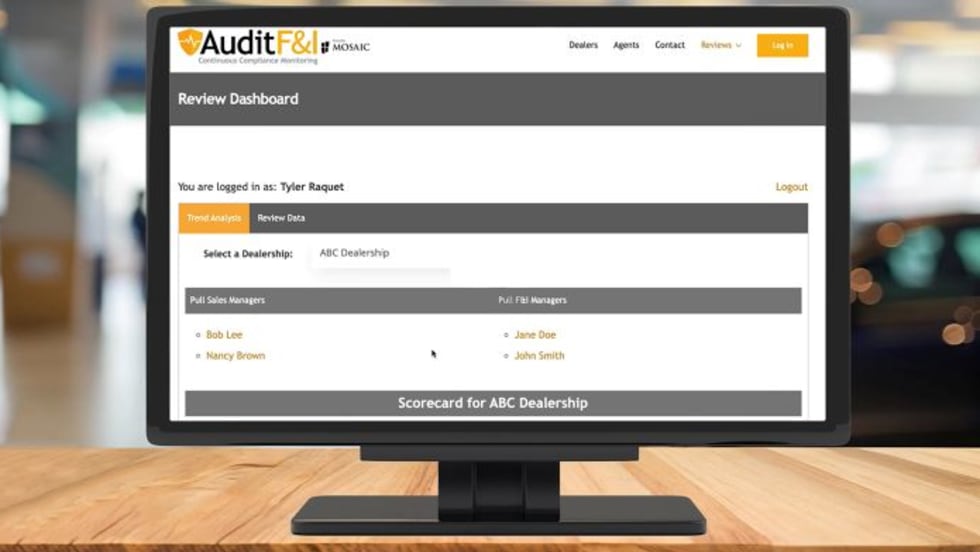
Mosaic Adds Continuous Monitoring With AuditF&I
New AuditF&I platform is designed to give dealerships a smarter way to stay compliant.
Read More →