


EVs Likely to Survive Losses
Hit from curtailing of government incentives elsewhere proved short-lived.

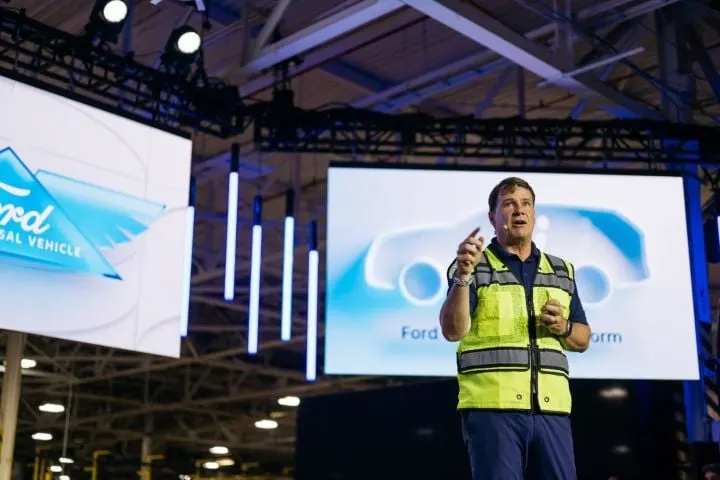
Ford CEO Jim Farley announcing in August a new assembly structure for the automaker's EVs.
Ford
Though the outlook for electric-vehicle sales has been dimming, one market watcher foresees only a temporary slowdown in adoption.
Based on patterns seen earlier in other countries, the end of government subsidies adopted to encourage EV sales shouldn’t be the death of the segment, J.D. Power analysts predict.
EV adoption in the U.S. faces a raft of obstacles erected by the Trump administration, including the Oct. 1 end of federal tax credits, weaker vehicle emissions restrictions, and scuttling of multiple states’ gas-powered car sale bans next decade. California, which leads the country in EV sales, said it won’t fill the tax credit gap by resuming its own subsidy.
U.S. EV adoption already lagged that of other countries and regions, slowed in part by limited charging infrastructure in more rural areas. But the loss of incentives stands to slow its progress. Given lower demand than anticipated, automakers had pulled back from plans just a few years ago to convert their entire lineups to electrified models, though they haven’t abandoned EVs, by any means. In fact, Ford recently announced a new assembly line structure for EV production, along with dealership chargers open to the general driving public.
However, based on EV adoption evolution in some other countries, the loss of government incentives shouldn’t threaten sales in the longer-term, according to analysis by J.D. Power. When national EV subsidies were phased out in both Canada and Germany, for instance, it said sales quickly sank but then gradually started returning to normal levels.
“… we see a fairly predictable trend in supply-demand dynamics taking root in the U.S. market,” J.D. Power said in its report.
Its research shows that U.S. consumer interest in EVs hasn’t wavered. Of those looking to buy or lease in the next 12 months, 59% say they’re very or somewhat likely to consider EVs, similar to interest levels over the past year.
Just the knowledge that the federal tax credit will expire drove many to buy or lease electric in recent months. In August, EVs’ new-vehicle retail market share tied December’s single-month record of 11%, up from 8% in May, J.D. Power said.
Still, consumers are price-conscious in today’s inflated market. Among those unlikely to go electric, 45% said price is a top factor in their hesitation, up three percentage points from July.
LEARN MORE: EVs Undergo Crash Tests With Mixed Results
Originally posted on Auto Dealer Today
More Industry

Charger Network Growth Slows
Despite a projected increase in public EV chargers in 2026, charging infrastructure remains a top concern for consumers as the gap between the most and least EV-friendly places remains substantial.
Read More →
Lenders, Consumers Take on More Auto Loan Risk
September records loosened credit access the most in over a decade as buyers took advantage of the conditions to afford trading, though loan applications fell.
Read More →
Next-Gen Hybrids in Sight
Dealerships can expect to see revamped hybrids from Honda next year as the company rolls out a new system and model lineup.
Read More →
Gem State Stores Change Hands
A larger auto group founded in the industry’s early years sold two franchises to a neighbor group that's on a growth spurt.
Read More →
Charging In Motion
Honda has been researching wireless in-motion charging for electric vehicles since 2025, and new technology developments have put it a step closer to a final product.
Read More →
Twin Cities Stores Sell
Minnesota-based Walser Automotive Group made what it called the most significant acquisition in its history with a three-rooftop deal in Minneapolis.
Read More →
U.S. Auto Sales Still Below Prepandemic Levels
Mobility Global industry observers don’t expect the market to return to the higher volumes that became routine before Covid but to stay well below its potential.
Read More →
The Powertrain Shift
Electric-vehicle owners are backpedaling, according to new data, with product availability driving many to shift back to gas-powered engines.
Read More →
Achromatic Autos
The shades that dominate the U.S. car market don’t call attention to themselves, though grayscale may have plateaued after a 30-year upswing, research shows.
Read More →
Used-Vehicle Affordability Worsens
Listing prices in August defied seasonal trends, rising above $27,000 for the second time this year.
Read More →