


Global Automakers Earmark Nearly US$600bn for EVs Over Next Decade
Broadly, the investments announced focus on the development of production facilities, technology, EV batteries, new product and securing future raw material supply, and autonomous vehicle development.

Broadly, the investments announced focus on the development of production facilities, technology, EV batteries, new product and securing future raw material supply, and autonomous vehicle development.
IMAGE: Global Data
GLOBAL DATA – Aggressive emission and carbon neutrality targets set by regulators worldwide entails a faster transition from traditional automakers to next-gen electric vehicle (EV) manufacturers. Therefore, automakers are committing operational investments of nearly US$600bn to secure their position in the future automotive market, says GlobalData, a leading data and analytics company.
Broadly, the investments announced focus on the development of production facilities, technology, EV batteries, new product and securing future raw material supply (primarily semiconductors and battery materials). Autonomous vehicle development also remains a closely linked area to the investments.
Bakar Sadik Agwan, Senior Automotive Consulting Analyst at GlobalData, comments: “The investments affirm that the future must be electric and there is no turning back for traditional automakers. However, the flurry of announcements from the OEMs could also be interpreted as a high-stakes game of one-upmanship or a corporate PR exercise to boost investor confidence. With all OEMs taking the same path, it is unlikely that any long-term sustainable competitive advantage will be conferred and that visibility over the billions of dollars of planned xEV investment is a price of market participation.”
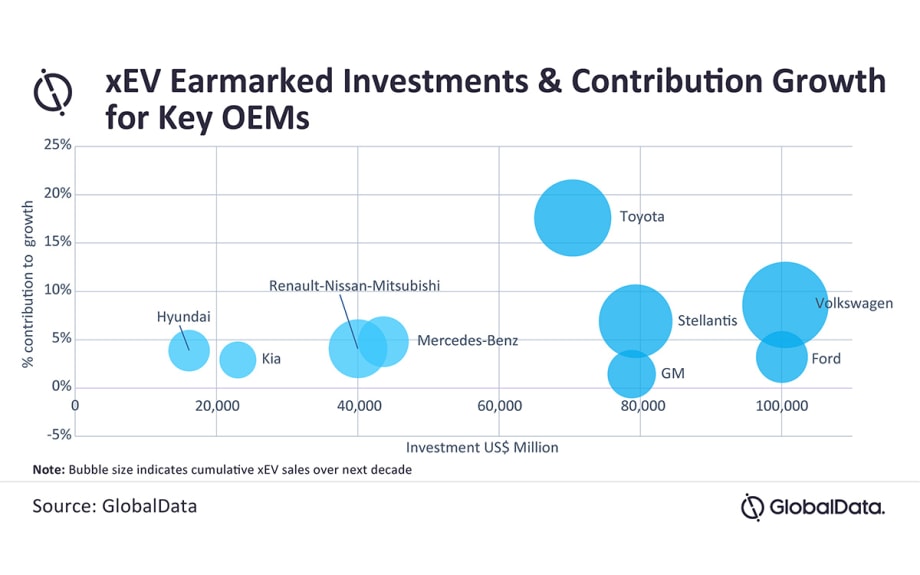
VW Group stays on the top of the list with US$100.5bn investment through 2030. Its ambition to surpass Tesla is no secret, and the company wants four out of every 10 cars it sells to be a BEV by 2030.
Agwan continues: “A further analysis, looking at the contribution to xEV growth of each OEM derived from the latest LMC light vehicle powertrain forecast, sheds further light on the returns expected. VW is estimated to have the highest cumulative contribution to EV growth over the next decade when mapped against the investment announced, amongst the players analyzed.
“However, there is no apparent correlation identified between the level of investment announced and expected contribution to growth as can be seen in the case of Ford, Stellantis and GM.”
However, despite being a pioneer in hybrid vehicles, Toyota was slow to implement BEV strategies. Which happened with President Akio Toyoda announcing the bZ EV brand last year and planning to launch 30 models by 2030. Prior to this, Toyota had only a few BEV models manufactured with its Chinese partner GAC Group. Toyota announced US$70.4bn investment in EVs to 2030, early this year.
Agwan concludes: “Toyota has the highest growth contribution given the level of investment announced but remains largely attributed to hybrid vehicles, followed by battery and hydrogen-powered vehicles. It is near the top of the game for companies active in the EV space. GlobalData’s alternative datasets signal Toyota’s leadership down the line. The company leads in deals (M&A, partnerships, JV, etc.) and is an innovation leader with the highest number of patents filed amongst other global automakers.
“Nevertheless, the investment announced remain important for automakers from a perspective of sustaining the ongoing disruptions in the automotive industry. Automakers need to be tech-efficient to combat technology rivals invading the auto industry.”
Originally posted on Auto Dealer Today
More Product & Technology

Integrating AI Into Your Admin System
It’s important for finance-and insurance administrators to build the technology into their existing systems instead of bolting it on.
Read More →
Public EV Charging Improves
The infrastructure buildout in the U.S. is providing more availability and safety at a better cost, according to the latest EV experience study by JD Power.
Read More →
AI in the Dealership
A Cox Automotive poll shows most dealers use it, but only some have found the smartest ways to adapt the surging technological sensation.
Read More →
AAA Honors Service and Repair Facilities
Three automotive dealerships made AAA's Service Providers of Excellence and Best in Repair list this year.
Read More →
EFG Launches Product Admin Platform
The company says the offering is designed to empower administrators, service contract providers, and product marketers to expand automotive and power-sports capabilities.
Read More →
Optimized Charging Could Reduce Costs
According to an Alliance for Automotive Innovation analysis, optimized EV charging could cut costs for drivers and improve grid infrastructure - potential adoption incentives.
Read More →
From Inspection to Impact
Data, video and artificial intelligence are driving service performance today, when inspection performance is closely tied to key business outcomes.
Read More →
Car Karaoke Gets Official Platform
The in-vehicle karaoke and sing-along platform by Samsung arm is meant to add traveling enjoyment safely in technology that automakers can tailor to their specific needs.
Read More →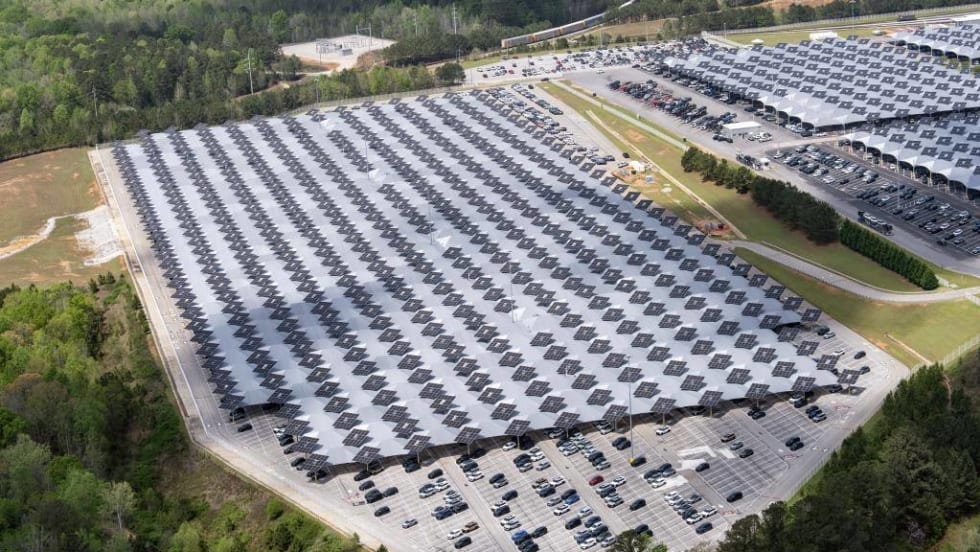
Kia Embraces Clean Energy
A Kia Georgia partnership combines weather protection and renewable energy in a new solar canopy system at Kia’s West Point facility.
Read More →
Honda-Sony Venture Dismantled
For nearly four years, the companies had worked toward the launch of the electric-vehicle brand’s first two models, but the shifting EV market scuttled the plans.
Read More →