


IHS: Average Age of U.S. Vehicles Continues to Rise
The average age of America’s registered cars and light trucks has risen again, to 11.8 years, according to the latest report from IHS Markit.


The average age of a car or light truck registered in the U.S. grew to 11.8 years and has increased 4% per year increase since 2014, according to the latest figures from IHS Markit.
Photo by Mariana Plozner via Pexels
SOUTHFIELD, Mich. — The average age of light vehicles in operation (VIO) in the U.S. has risen again this year to 11.8 years, according to new research from business information provider IHS Markit.
Analysts noted this acceleration of average age can easily be seen when looking across the last 17 years: From 2002 to 2007, the average age of light vehicles in the U.S. increased by 3.5%. From 2008 to 2013, however, the increase was 12.2%. Over the last five years, the average age increase has returned to its more traditional rate, aging by 4% over this time period.
“Better technology and overall vehicle quality improvements continue to be key drivers of the rising average vehicle age over time,” said Mark Seng, director, global automotive aftermarket practice at IHS Markit. “The 40% drop in new-vehicle sales due to the recession created an acceleration in average age like we’ve never seen before. In the last couple of years, however, average age has returned to its more traditional rate of increase.”
Light vehicles in operation in the U.S. have now reached a record level of more than 278 million, according to the analysis — an increase of more than 5.9 million (2.2%) since 2018. This represents one of the highest annual increases the U.S. auto industry has seen since IHS Markit began tracking VIO growth — second only to the 2.3% growth in 2016.
“The increasing VIO fleet is providing a robust new business pipeline for the aftermarket,” said Seng. “A larger fleet means more service and repair opportunities in the future.”
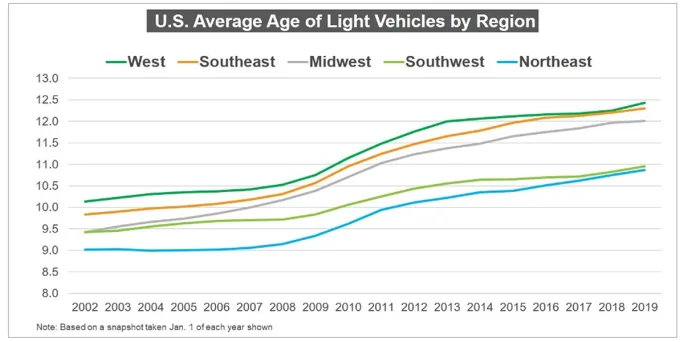
The West leads all U.S. regions with an average light-vehicle age of 12.4 years.
Source: IHS Markit
For the first time, the analysis included a review of various regions around the country. The oldest light vehicles are found in the West at 12.4 years while the youngest are found in the Northeast at 10.9 years. In addition, the light vehicle fleet is not aging at the same rate across regions. In the West, light vehicles increased 1.5% from 2018 to 2019 while in the Midwest they aged by just 0.4%. The state of Montana has the oldest average age with light vehicles averaging 16.6 years. The youngest average age is in Vermont, where the average age of light vehicles is 9.9 years.
Because of the growth in popularity of light trucks — including CUVs/SUVs — vehicle age in the U.S. is also increasing at different rates across vehicle segments. From 2018-2019, the average age of passenger cars increased 2.2% while light trucks aged at a rate of just 0.1%.
Analysts said the shifting dynamic of the age of vehicles in operation indicates the volumes of vehicles in the new to five-year-old category will grow 2% from 2018 to 2023, while vehicles in the six- to 11-year-old range will grow 27%. This is a very positive trend for the independent aftermarket as it points to a growing repair “sweet spot” — or growth in the vehicles which drive the most repair opportunities. In contrast, vehicles 12-15 years old will decline 27% over the same time period.
“While the decrease in light vehicles 12-15 years of age looks alarming, it relates to the drop in sales due to the recession,” said Seng. “There is simply a lack of 2008 and 2009 model year vehicles due to the lower sales numbers during that timeframe. Even the model years from early in the recovery are lower in number. This disruption simply needs time to work its way through the fleet.”
Originally posted on Auto Dealer Today
More Industry

Charger Network Growth Slows
Despite a projected increase in public EV chargers in 2026, charging infrastructure remains a top concern for consumers as the gap between the most and least EV-friendly places remains substantial.
Read More →
Lenders, Consumers Take on More Auto Loan Risk
September records loosened credit access the most in over a decade as buyers took advantage of the conditions to afford trading, though loan applications fell.
Read More →
Next-Gen Hybrids in Sight
Dealerships can expect to see revamped hybrids from Honda next year as the company rolls out a new system and model lineup.
Read More →
Gem State Stores Change Hands
A larger auto group founded in the industry’s early years sold two franchises to a neighbor group that's on a growth spurt.
Read More →
Charging In Motion
Honda has been researching wireless in-motion charging for electric vehicles since 2025, and new technology developments have put it a step closer to a final product.
Read More →
Twin Cities Stores Sell
Minnesota-based Walser Automotive Group made what it called the most significant acquisition in its history with a three-rooftop deal in Minneapolis.
Read More →
U.S. Auto Sales Still Below Prepandemic Levels
Mobility Global industry observers don’t expect the market to return to the higher volumes that became routine before Covid but to stay well below its potential.
Read More →
The Powertrain Shift
Electric-vehicle owners are backpedaling, according to new data, with product availability driving many to shift back to gas-powered engines.
Read More →
Achromatic Autos
The shades that dominate the U.S. car market don’t call attention to themselves, though grayscale may have plateaued after a 30-year upswing, research shows.
Read More →
Used-Vehicle Affordability Worsens
Listing prices in August defied seasonal trends, rising above $27,000 for the second time this year.
Read More →