


Lawmakers Question Ford Deal With Chinese Firm
House committees express concerns over human rights regarding Michigan battery plant project.

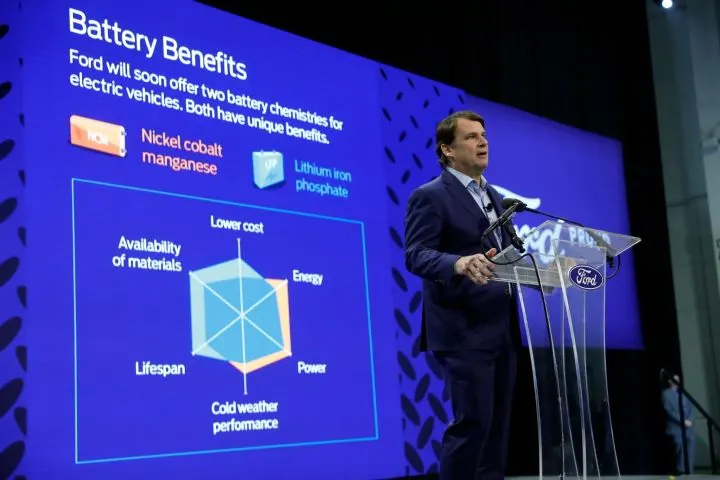
Ford President and CEO Jim Farley announcee plans for the battery plant in February, saying it was the first automaker to commit to build both nickel cobalt manganese (NCM) and lithium iron phosphate (LFP) batteries in the U.S. and saying the project would diversify and localize its battery-supply chain, improving availability and affordability and 'strengthening consumer demand.'
IMAGE: Ford
Republican congressmen are investigating Ford’s partnership with Chinese battery maker CATL, according to news reports.
The chairmen of the House Select Committee on the Chinese Communist Party and the House Ways and Means Committee sent Ford a letter Thursday seeking more details about the partnership.
Ford announced plans for a $3.5 billion battery factory in February utilizing technology and services by CATL, the world’s biggest maker of batteries for electric vehicles.
The congressmen expressed disquiet that the relationship between the Dearborn, Mich.-based automaker and the Chinese concern might involve forced labor at a company CATL has had ownership interest in in Xinjiang, saying that CATL moved to maintain control of the company while giving the appearance of divesting itself of the operation.
The committees also expressed concern that several hundred Chinese workers would work at the Ford factory.
When Ford announced the battery plant project, it said the LFP battery chemistry to be used there “helps reduce reliance on critical minerals such as nickel and cobalt and is in line with Ford’s work to create an EV supply chain that upholds its commitments to sustainability and human rights.”
Ford said in news reports that it will respond to the committees' letter and that it’s committed to human rights.
The Biden administration has worked to increase U.S. EV production and materials sourcing to decrease reliance on Chinese markets, offering incentives and loans to companies that pursue such operations.
LEARN MORE: Ford JV Gets Major US Loan for Battery Plants
Originally posted on Auto Dealer Today
More Industry

Charger Network Growth Slows
Despite a projected increase in public EV chargers in 2026, charging infrastructure remains a top concern for consumers as the gap between the most and least EV-friendly places remains substantial.
Read More →
Lenders, Consumers Take on More Auto Loan Risk
September records loosened credit access the most in over a decade as buyers took advantage of the conditions to afford trading, though loan applications fell.
Read More →
Next-Gen Hybrids in Sight
Dealerships can expect to see revamped hybrids from Honda next year as the company rolls out a new system and model lineup.
Read More →
Gem State Stores Change Hands
A larger auto group founded in the industry’s early years sold two franchises to a neighbor group that's on a growth spurt.
Read More →
Charging In Motion
Honda has been researching wireless in-motion charging for electric vehicles since 2025, and new technology developments have put it a step closer to a final product.
Read More →
Twin Cities Stores Sell
Minnesota-based Walser Automotive Group made what it called the most significant acquisition in its history with a three-rooftop deal in Minneapolis.
Read More →
U.S. Auto Sales Still Below Prepandemic Levels
Mobility Global industry observers don’t expect the market to return to the higher volumes that became routine before Covid but to stay well below its potential.
Read More →
The Powertrain Shift
Electric-vehicle owners are backpedaling, according to new data, with product availability driving many to shift back to gas-powered engines.
Read More →
Achromatic Autos
The shades that dominate the U.S. car market don’t call attention to themselves, though grayscale may have plateaued after a 30-year upswing, research shows.
Read More →
Used-Vehicle Affordability Worsens
Listing prices in August defied seasonal trends, rising above $27,000 for the second time this year.
Read More →