


China at the Wheel
A growing force in the automotive industry can’t be ignored.

Today 64% of vehicles sold in China – a market now double the size of the U.S. – are manufactured and sold by domestic Chinese brands, up from 36% in 2020.
Pexels/Aditya Agarwal
China is rapidly redefining the global automotive industry, and potentially the U.S. market.
It’s the largest auto retail market in the world, surpassing the U.S. in 2009 (see chart). Now Chinese OEMs are on the verge of becoming the world’s largest automakers. Today China represents 40% of global auto production relative to the 10% U.S. share. The country leverages its superior cost efficiencies, government-backed initiatives and aggressive expansion strategies to accelerate its global market share gains.
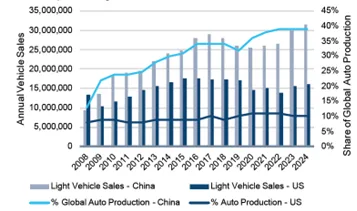
Sources: China Association of Automobile Manufacturers, CEIC, Macrobond, Automotive News, Kerrigan Advisors’ Research & Analysis
Kerrigan Advisors
Today 64% of vehicles sold in China – a market now double the size of the U.S. – are manufactured and sold by domestic Chinese brands, up from 36% in 2020. By contrast, legacy automakers have seen their market share decline to just 36%. The rapid ascent of China’s domestic brands in China, at the expense of imports, signals a potential reshuffling of the global auto industry, with Chinese manufacturers poised to extend their market dominance beyond their home market.
The financial ramifications to legacy OEMs of lost market share in the world’s largest auto market are becoming increasingly apparent. Seventy percent of OEM executives surveyed by Kerrigan Advisors now have concerns about the financial impact of Chinese OEMs’ rising global market share. This is perhaps not surprising when considering how the automakers that suffered the most significant declines in Chinese market share had historically relied on China for a meaningful percentage of their global sales.
OEMs’ concern about the financial impact of their Chinese counterparts are becoming a reality as their earnings are now being negatively impacted by the lost sales. One of the most striking examples is General Motors, which recorded a $5 billion restructuring charge in the fourth quarter of 2024 due to the deterioration of its Chinese business. To put this into perspective, GM’s China charge represents 70% of the company’s 2024 net income, underscoring the financial gravity of the shifting competitive realities.
As legacy OEMs experience the financial fallout from their shrinking China presence, they have concerns about Chinese OEMs entering the lucrative U.S. market, the only major auto retail market in the world where Chinese OEMs are absent. This makes the U.S. a highly attractive auto retail market for legacy OEMs. However, 76% of U.S. auto executives surveyed by Kerrigan Advisors expect Chinese automakers to eventually enter the U.S. market, indicating the barrier to entry may be short-lived.
While the U.S. has successfully shielded its auto retail market from Chinese imports for now, the global rise of Chinese OEMs – and the potential for their future entry into the U.S. – will inevitably impact legacy automakers’ U.S. strategy, operations and associated blue-sky values. Blue sky represents the intangible value of a franchise, driven by an OEM’s ability to sustain a profitable dealer network with compelling, innovative products. When an automaker loses global market share and suffers the financial implications of that loss, its blue-sky value often declines.
Whether Chinese vehicles enter the U.S. market directly or not, their growing dominance in the global auto industry will have financial consequences for U.S. auto retailers. As the competitive conditions continue to shift, U.S. dealers should closely monitor the financial health and strategic global positioning of their franchise OEMs, ensuring they align with brands capable of sustained investment and long-term viability in an evolving global marketplace. Fully insulating the U.S. auto market and blue-sky values from the impact of the Chinese auto industry likely has an expiration date.
Erin Kerrigan is founder and managing director of Kerrigan Advisors, a sell-side adviser to U.S. dealerships that has represented on the sale of more than 400 franchises.
EDITOR’S NOTE: This article was authored and edited according to F&I and Showroom editorial standards and style. Opinions expressed may not reflect that of the publication.
Originally posted on F&I and Showroom
More Industry

Charger Network Growth Slows
Despite a projected increase in public EV chargers in 2026, charging infrastructure remains a top concern for consumers as the gap between the most and least EV-friendly places remains substantial.
Read More →
Lenders, Consumers Take on More Auto Loan Risk
September records loosened credit access the most in over a decade as buyers took advantage of the conditions to afford trading, though loan applications fell.
Read More →
Next-Gen Hybrids in Sight
Dealerships can expect to see revamped hybrids from Honda next year as the company rolls out a new system and model lineup.
Read More →
Gem State Stores Change Hands
A larger auto group founded in the industry’s early years sold two franchises to a neighbor group that's on a growth spurt.
Read More →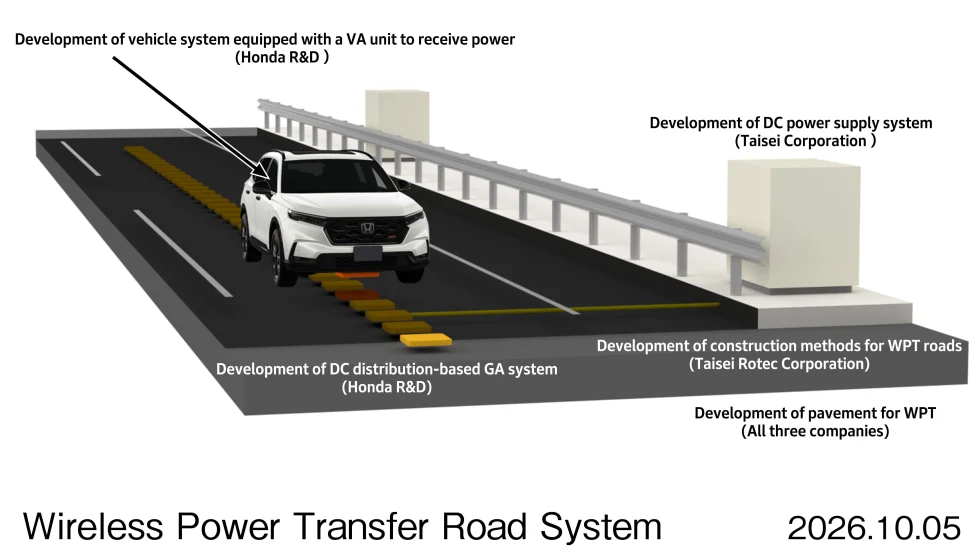
Charging In Motion
Honda has been researching wireless in-motion charging for electric vehicles since 2025, and new technology developments have put it a step closer to a final product.
Read More →
Twin Cities Stores Sell
Minnesota-based Walser Automotive Group made what it called the most significant acquisition in its history with a three-rooftop deal in Minneapolis.
Read More →
U.S. Auto Sales Still Below Prepandemic Levels
Mobility Global industry observers don’t expect the market to return to the higher volumes that became routine before Covid but to stay well below its potential.
Read More →
The Powertrain Shift
Electric-vehicle owners are backpedaling, according to new data, with product availability driving many to shift back to gas-powered engines.
Read More →
Achromatic Autos
The shades that dominate the U.S. car market don’t call attention to themselves, though grayscale may have plateaued after a 30-year upswing, research shows.
Read More →
Used-Vehicle Affordability Worsens
Listing prices in August defied seasonal trends, rising above $27,000 for the second time this year.
Read More →