


Black Book: Weekly Market Update
The overall market continued to decline this past week, but the rate of depreciation lessened, and some segments reported positive pricing movement.

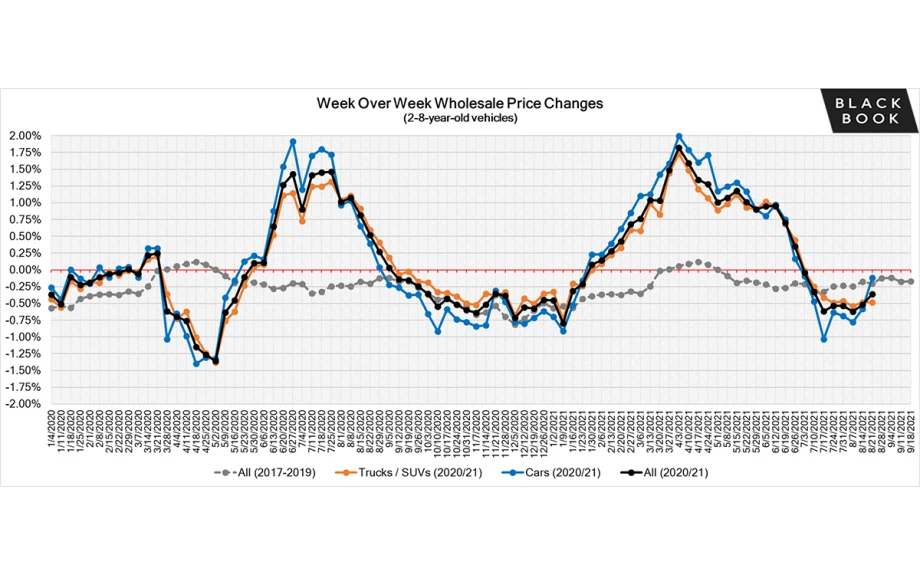
The overall market continued to decline this past week, but the rate of depreciation lessened, and some segments reported positive pricing movement.
BLACK BOOK – Wholesale Prices, Week Ending August 21st
The overall market continued to decline this past week, but the rate of depreciation lessened, and some segments reported positive pricing movement. Despite the lower level of depreciation this past week, the rate of weekly decline remains at a level that is larger than the overall market traditionally experiences this time of year.
This Week Last Week 2017-2019 Average (Same Week)
Car segments -0.12% -0.58% -0.19%
Truck & SUV segments -0.48% -0.48% -0.21%
Market -0.36% -0.52% -0.21%
Car Segments
On a volume-weighted basis, the overall Car segment decreased -0.12%. For reference, the previous week decreased by –0.58%.
Sub-Compact Car (-0.74%), Prestige Luxury Car (-0.55%), and Sporty Car (-0.90%) had the largest declines this past week. Sub-Compact Car had twenty-five weeks of gains, so it is no surprise that the past three weeks have had large declines. For comparison, the prior weeks’ change was -0.91%.
Six of the nine car segments reported stability with only small increases or decreases in wholesale values.
Truck / SUV Segments
The volume-weighted, overall Truck segment declined -0.48%, which is the same as the previous week’s decline of -0.48%.
All three van segments had gains again last week, with Minivan increasing +0.72%, Full-Size Van up +0.50%, and Compact Van moving by a smaller +0.18%.
Full-Size Pickups have seen increasing rates of depreciation in recent weeks, with the 1500 series trucks driving the declines due to new vehicle incentives still being available. 2500 and 3500 trucks remain in short supply, with lower incentives.
Weekly Wholesale Index
Calendar year 2020 ended with used wholesale prices at elevated levels. With economic patterns (including the automotive market) driven by the pandemic, normal seasonal patterns (e.g., 2019 calendar year) in the wholesale market were not observed for most of the year. We saw a similar picture in 2009, at the end of the Great Recession. Calendar year 2021 has not had typical seasonality patterns as the market has had rapid increases in wholesale values for the majority of the year. After reaching record heights at the end of June, wholesale prices are now declining at rates higher than the typical seasonal decline.
The graph below looks at trends in wholesale prices of 2-6-year-old vehicles, indexed to the first week of the year.
Retail (Used and New) Insights
Up until now, Toyota has been unaffected by the microchip shortage, but they announced last week they will be making cuts to production because of the shortage. They are estimating this will cut their September global volume by 40%.
Ford also made headlines last week, with more planned plant closures, this time for the F-150.
General Motors has had production disruptions to most of their product line-up and the list of affected models continues to grow. The latest to fall victim to the microchip shortage are the Chevrolet Bolt EV and EUV. Additional downtime is also planned this week for some of their SUVs and sedans.
Genesis revealed their first electric crossover, the GV60. The compact crossover is set to go on sale in the US next year.
Used Retail Prices
With the proliferation of ‘no-haggle pricing’ for used-vehicle retailing, asking prices accurately measure trends in the retail space. Retail demand slowed down at the end of last year, and thus resulted in declining retail asking prices for the last several weeks of 2020. As demand rebounded, retail prices have lagged slightly behind wholesale prices, but March had an accelerated growth in retail prices. In April and May, retail prices picked up speed as demand accelerated, fueled by stimulus payments, tax season, and shortages of new inventory. In June, retail prices continued to rise. After strong Spring and Summer months, retail listing prices seemed to stabilize at a level more than 24% above where we started the year.
This analysis is based on approximately two million vehicles listed for sale on US dealer lots. The graph below looks at 2-6-year-old vehicles.
Inventory
Used Retail
Current used retail listing volume is about 13% below the start of the year. Used inventory is now starting to decrease again due to slow down in trade-ins and lease returns.
Days-to-turn for used retail listings have been increasing, as retail demand softened over the last few weeks. The days-to-turn now sits just below 33 days, which is still lower than what is typically expected in a normal year.
Wholesale
Sales rates have been continually improving in recent weeks as sellers have adjusted floors to reflect the softening in wholesale values.
The news of Toyota’s plans to cut 40% of their September production has dealers anticipating the demand for used vehicles will continue. New car dealers have already been reporting they are at historic lows of available new inventory.
The industry will come together in-person this week for the National Independent Automobile Dealers Association (NIADA) convention and the International Automotive Remarketing Alliance’s (IARA) Summer Roundtable in San Antonio, Texas.
Originally posted on F&I and Showroom
More Industry

Charger Network Growth Slows
Despite a projected increase in public EV chargers in 2026, charging infrastructure remains a top concern for consumers as the gap between the most and least EV-friendly places remains substantial.
Read More →
Lenders, Consumers Take on More Auto Loan Risk
September records loosened credit access the most in over a decade as buyers took advantage of the conditions to afford trading, though loan applications fell.
Read More →
Next-Gen Hybrids in Sight
Dealerships can expect to see revamped hybrids from Honda next year as the company rolls out a new system and model lineup.
Read More →
Gem State Stores Change Hands
A larger auto group founded in the industry’s early years sold two franchises to a neighbor group that's on a growth spurt.
Read More →
Charging In Motion
Honda has been researching wireless in-motion charging for electric vehicles since 2025, and new technology developments have put it a step closer to a final product.
Read More →
Twin Cities Stores Sell
Minnesota-based Walser Automotive Group made what it called the most significant acquisition in its history with a three-rooftop deal in Minneapolis.
Read More →
U.S. Auto Sales Still Below Prepandemic Levels
Mobility Global industry observers don’t expect the market to return to the higher volumes that became routine before Covid but to stay well below its potential.
Read More →
The Powertrain Shift
Electric-vehicle owners are backpedaling, according to new data, with product availability driving many to shift back to gas-powered engines.
Read More →
Achromatic Autos
The shades that dominate the U.S. car market don’t call attention to themselves, though grayscale may have plateaued after a 30-year upswing, research shows.
Read More →
Used-Vehicle Affordability Worsens
Listing prices in August defied seasonal trends, rising above $27,000 for the second time this year.
Read More →