

Product & Technology
Set Yourself Apart
Product providers can follow the lead of industry cohorts in the practice of leveraging their brands through private labeling, pumping new energy into their platforms to stand out from competitors.

 MENU
MENU SEARCH
Buffeted by trial after trial as a young man, David Wright knew he’d found his life path when he stumbled into auto retail after all other doors slammed shut. The 2026 Time Dealer of the Year shares the lessons he learned along the way.
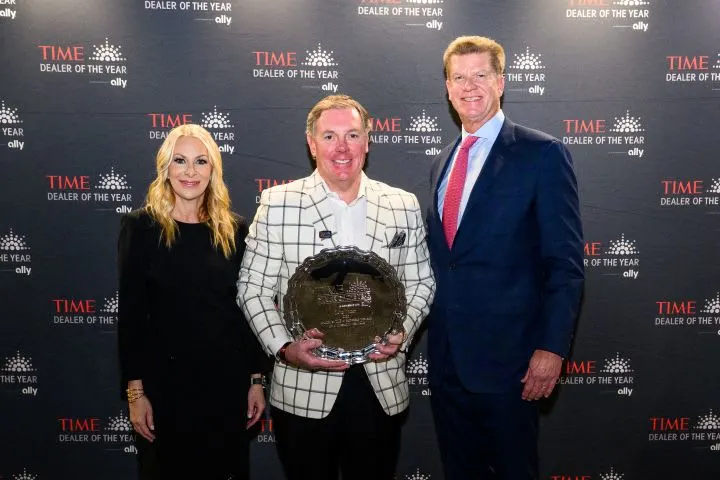
David Wright, center, accepts the 2026 Time Dealer of the Year award at this year's NADA Show in Las Vegas
Ally
From the time he was a high school student looking for ways to fund college, David Wright saw himself as a helicopter pilot.
Though he may not have known it then, such a role feeds on the kind of independence that comes naturally for him, along with self-confidence, assertiveness and competitiveness.
His aim to pilot helicopters for the Army National Guard part time was even fast-tracked by Wright’s college ROTC instructor, who arranged for early aptitude tests.
The dream came crashing down, though, with a cancer diagnosis before Wright could realize either it or a college degree.
Though both detours were blows to the young man, he was fortunate in that he ultimately recovered his health after a six-year battle with the cancer. And the same traits that would’ve made him a successful helicopter pilot happened to also be keys to auto retailing.
Not that Wright had thought about becoming a car dealer. No, he’d simply visited a local bank in the Iowa town where his fiancée had recently landed a teaching job, a town he didn’t care for. There, he hoped to secure an underwriting gig while he bided his time, thinking the couple could move elsewhere after a year.
But the banker he talked with that day discouraged the idea, saying underwriting roles were headed for the chopping block. Instead, he suggested the eager young man visit a local car dealership that was looking for a finance-and-insurance manager.
Wright had majored in business in college with a finance focus, so the idea made sense, and he took the banker’s advice. He indeed got the F&I job at the local Buick, GMC, Oldsmobile and Honda dealership. In fact, he never looked back, even staying in the town he hated for 14 years as he married, started a family and climbed the auto retail ladder, which fit for him like a pilot in a cockpit.
Reflecting on the unexpected turn in his life at such a young age, the 2026 Time Dealer of the Year sees the logic of it.
Chiefly, he knew even in his 20s that he’d ultimately want to be his own boss. Already he’d traded stocks and even bought apartment buildings. He just didn’t know exactly what that would look like.
At the Iowa dealership, he soon learned, and his career journey serves as a useful template for anyone thinking about entering the business or eventually owning their own dealership.
Wright happily thrived in the entrepreneurial environment that’s a hallmark of auto retail.
“I’m an AA-plus type, so I love the concept of five different businesses inside of one business, different business models that work together to succeed,” he said. “One department’s ratios are nowhere near the others, but it all works well.”
The dealer, who now owns his own Nissan and Subaru franchises in Hiawatha, Iowa, enjoyed the business challenges, along with the festive air that comes with consumers making exciting purchases.
Over the next seven years, Wright got his legs and saw success by tapping his natural skills. He also came to peace with the town he used to hate after establishing a community of friends and relinquishing the dream of living in a big city.
An opportunity presented itself to buy half of a second-generation Ford dealership that had seen better years, and Wright seized on it. He now had more skin in the game, and that felt right to him, despite early challenges.
“I had sales down pretty good, but I didn’t understand the parts and service business like I should. Especially in a Ford store you should have a significant parts and service department.”
Realizing his new learning curve, Wright quickly joined a 20 group peer forum to learn from industry veterans the likes of Larry Geweke and the Farhneys in California’s Central Valley, Paul Cotton in Chicago, Jerry Korum in Washington state, and Mike Finnin in Wright’s home state.
“They’re successful,” he remembers. “They’re making real money. They all embraced me and taught me a lot.”
Wright needed all the support he could get. He might have landed in the business indirectly, but he had now chosen to stay in it, but that didn’t mean the road was all clear.
“I remember writing a huge check. I had to borrow to make payroll” in his first month running the Ford store for the founder’s two sons, he says. He acknowledged the many sharp curves in auto retail.
“It’s a tough business. Margins are really slim. I think the national average now is 1.5% … With customers it’s always a haggle. It’s tough to get employees sometimes. But you’ll always have a new group to step in. You’ll get in the car business if you want it.”
When Wright felt like the Ford dealership was on solid footing, he took the next leap, buying his own store outright in 2004, the Nissan Subaru franchises he runs today.
Over the next two decades, he built the business and got involved in industry leadership through board service for the Iowa Automobile Dealers Association, serving as chairman of the 300-plus-member trade group.
And like most auto dealers, he also supported many local charities, including one particularly close to his heart that provides Thanksgiving turkey dinners for local families in need. Wright, his wife, Patty, and their children make many of the more than 2,000 deliveries each year.
Having business and finance smarts, plus an analytical bent, certainly gave him a leg up on rivals in a famously competitive industry. But he says something else helped him achieve more than marginal success.
“Our people and our culture,” he answered quickly when asked how he went from a young man with no college degree or concrete prospects to a becoming a standout in a tough business.
Wright said that early on he sought to run his dealership with integrity from the top down. He’d observed some dealers in the past focus on themselves and wanted to approach his business differently.
“I thought if we served our customers and each other better than anybody else that we’d be a place where people would want to come to do business,” he said. “If you can’t have a servant mentality, you can’t work for us.”
Wright believes that mindset helps employees relax and have fun rather than focus on winning for themselves, removing “a lot of the negative components of negotiating.”
Every day at the dealership, “We say, ‘How many people did you serve today?’”
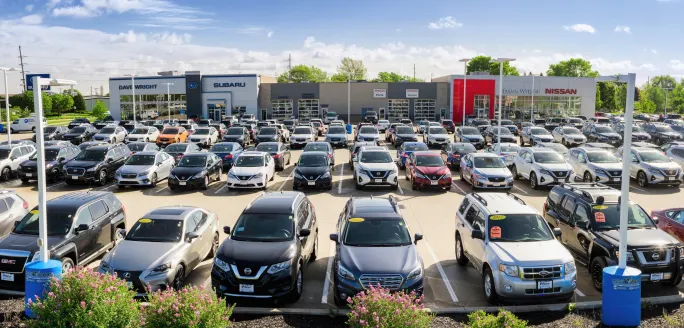
Wright said he's run his dealership with integrity from the top down after seeing some dealers in the past focus on themselves.
David Wright Nissan Subaru
The struggles and sacrifices Wright has made in his career have been worth the payoff he’s achieved, he said, not only in business returns but in a satisfied workforce, grateful community beneficiaries, and the challenge of overcoming career curveballs.
He knows the business chews a lot of people up and spits them out in a quickly consolidating industry.
“There are not many first-generation dealers left. There are so many capital requirements; manufacturers want a lot of money. It takes big money to buy them now,” Wright says.
“I wouldn’t have had the resources to buy in right now … I barely did 20 years ago. It was nip and tuck. I had a lot of sleepless nights hoping checks would cash the next day.”
He hadn’t expected the Time Dealer of the Year honor because the organizers of the annual ceremony don’t tip winners off beforehand. So he had no prepared speech and was flabbergasted when called to the stage at this year’s NADA Show to accept the award.
“I went into instant panic and truly humbled, all at the same time.”
Loading data...
Product & Technology
Product providers can follow the lead of industry cohorts in the practice of leveraging their brands through private labeling, pumping new energy into their platforms to stand out from competitors.







Product & Technology
It’s important for finance-and insurance administrators to build the technology into their existing systems instead of bolting it on.
Compliance
Recent state insurance department regulator actions signal that it’s expanding regulatory risk for the VSC industry, whose players should prepare themselves for compliance.
Product & Technology
Data, video and artificial intelligence are driving service performance today, when inspection performance is closely tied to key business outcomes.
Awards
Buffeted by trial after trial as a young man, David Wright knew he’d found his life path when he stumbled into auto retail after all other doors slammed shut. The 2026 Time Dealer of the Year shares the lessons he learned along the way.
Industry
Understanding the risks and benefits of retail accounting and Super CFCs can help you better present options to your dealer partners.
Actuary
The Kerper Bowron Method is a patent-pending approach that builds on established actuarial principles but applies them at the individual contract level.
Industry
Providers and administrators should clearly and credibly communicate their experiences since their numbers will draw more scrutiny this year.
Compliance
In Trump’s first year, just 60,917 pages were printed in the Federal Register, the official journal of the federal government, down 42%.
Industry
As America turns 250, explore how the automotive industry shaped jobs, culture, innovation, and mobility from Detroit assembly lines to today’s EV era.