


California DMV Accuses Tesla of Exaggerating Hands-free Driving Software Capabilities
The California Department of Motor Vehicles has asked for an administrative hearing that could result in penalties.

Tesla
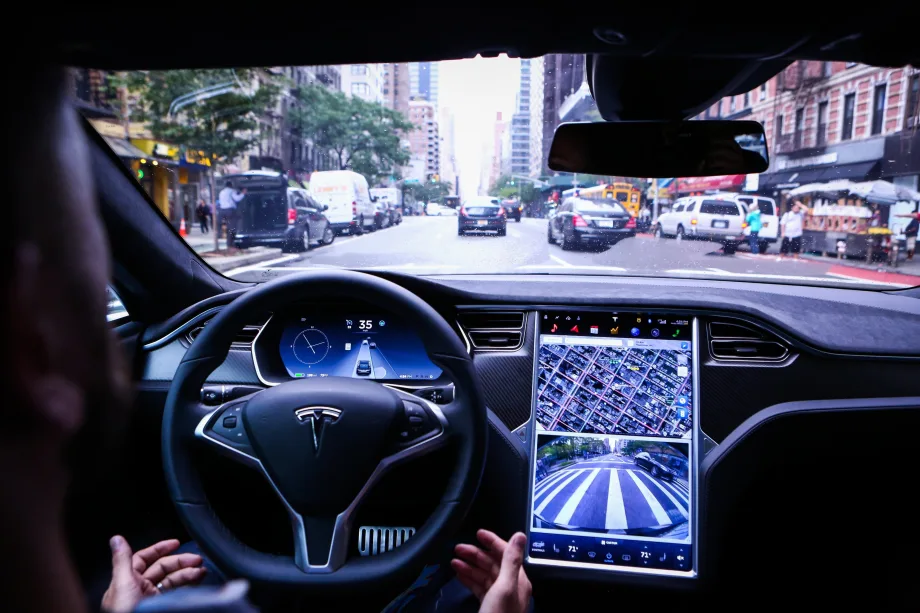
The California Department of Motor Vehicles has accused Tesla of exaggerating the capabilities of its hands-free driving software. The agency has asked for an administrative hearing that could result in penalties.
Tesla offers three levels of automation on its vehicles. Each level offers different capabilities, but none give consumers a true autonomous vehicle.
Autopilot comes standard equipment on every Tesla vehicle. It includes a smart cruise control that matches the car’s speed to the speed of surrounding traffic and a lane-centering function to keep the car in the center of its lane.
Enhanced Autopilot, a $6,000 option on all Tesla vehicles, which offers the same features as Autopilot but adds the ability to navigate highway on- and off-ramps and highway interchanges without driver input, and to suggest lane changes. This level also includes a self-parking system and a “summon” function that lets owners call the car to them from across a parking lot.
Full Self-Driving costs consumers $12,000. This system lets the car read and react to traffic lights and stop signs with the driver’s “active supervision.” Owners can use this system today but must agree to a series of waivers to activate it. Tesla reports the system is still in “beta testing.”
The California DMV claims Tesla “made or disseminated statements that are untrue or misleading, and not based on facts.” By naming the products “autopilot” and “full self-driving,” the DMV alleges Tesla suggests the systems operate autonomously.
But SAE requires active driver supervision with autonomous capabilities such as those offered by Tesla. The automaker has since added a disclaimer stating “the currently enabled features require active driver supervision and do not make the vehicle autonomous.”
A collective group of automotive safety groups have asked the auto industry to agree on standardized names for autonomous systems to avoid confusion.
Tesla has offered up information that explains how Full Self-Driving is “not capable of recognizing or responding to static objects and road debris, emergency vehicles, construction zones, large uncontrolled intersections with multiple incoming ways, occlusions, adverse weather, complicated or adversarial vehicles in the driving path, and unmapped roads.”
California DMV maintains this disclaimer is not enough.
If the DMV prevails in its lawsuit, it could revoke the company’s licenses to make or sell its cars in California.
But in a KMB.com article, a DMV spokesperson hinted the agency wouldn’t take things that far. Instead, will require Tesla to advertise to consumers and better educate Tesla drivers about the capabilities of its ‘Autopilot’ and ‘Full Self-Driving’ features.”
Originally posted on Auto Dealer Today
More Product & Technology

Set Yourself Apart
Product providers can follow the lead of industry cohorts in the practice of leveraging their brands through private labeling, pumping new energy into their platforms to stand out from competitors.
Read More →
EVs Excel at Longevity
Research finds that after a certain mileage point, they outlast gas and diesel vehicles despite being driven more.
Read More →
Integrating AI Into Your Admin System
It’s important for finance-and insurance administrators to build the technology into their existing systems instead of bolting it on.
Read More →
Public EV Charging Improves
The infrastructure buildout in the U.S. is providing more availability and safety at a better cost, according to the latest EV experience study by JD Power.
Read More →
AI in the Dealership
A Cox Automotive poll shows most dealers use it, but only some have found the smartest ways to adapt the surging technological sensation.
Read More →
AAA Honors Service and Repair Facilities
Three automotive dealerships made AAA's Service Providers of Excellence and Best in Repair list this year.
Read More →
EFG Launches Product Admin Platform
The company says the offering is designed to empower administrators, service contract providers, and product marketers to expand automotive and power-sports capabilities.
Read More →
Optimized Charging Could Reduce Costs
According to an Alliance for Automotive Innovation analysis, optimized EV charging could cut costs for drivers and improve grid infrastructure - potential adoption incentives.
Read More →
From Inspection to Impact
Data, video and artificial intelligence are driving service performance today, when inspection performance is closely tied to key business outcomes.
Read More →
Car Karaoke Gets Official Platform
The in-vehicle karaoke and sing-along platform by Samsung arm is meant to add traveling enjoyment safely in technology that automakers can tailor to their specific needs.
Read More →