


Cornered Fed Announces First Rate Cut Since 2008
Facing new global realities and pressure on multiple fronts, the Federal Reserve cut interest rates for the first time in more than a decade in an attempt to prolong the economic expansion.

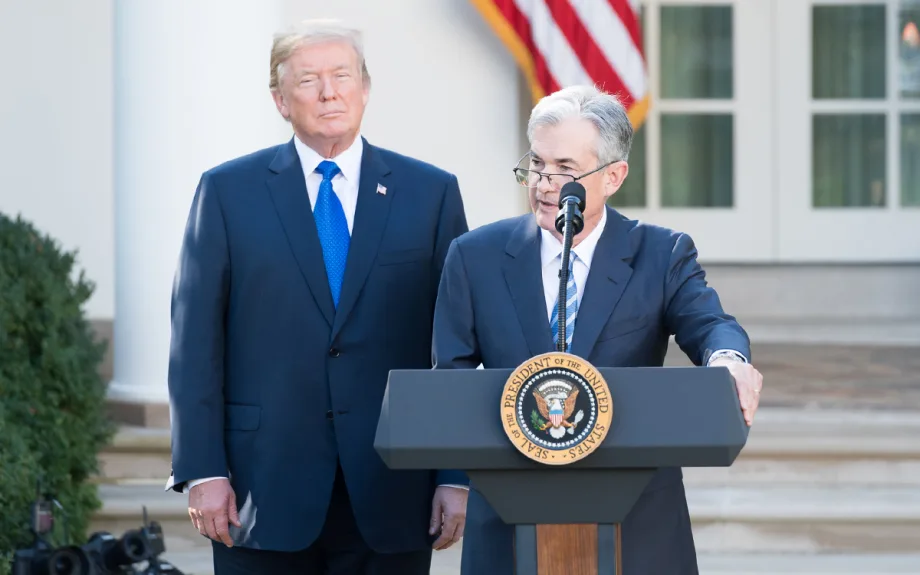
Jerome Powell, seen here with President Donald Trump upon the 2017 announcement of his nomination as Fed chair, has faced pressure from Trump and others to reverse course on planned interest-rate hikes.
Photo courtesy The White House via Flickr
WASHINGTON — Federal Reserve Chairman Jerome Powell officially announced a widely expected cut to the federal funds rate yesterday, dropping the central bank’s target by a quarter-point to 2%. The reduction is the first since 2008, in the early stages of the Great Recession.
Powell referred to the move as a “midcycle adjustment,” declining to commit to further cuts.
“It’s not the beginning of a long series of rate cuts — I didn’t say it’s just one,” Powell said at a press conference. “What we’re seeing is that it’s appropriate to adjust policy to a somewhat more accommodative stance over time, and that’s how we’re looking at it.”
Traditional Fed policy calls for rate hikes during times of economic prosperity, a course officials followed throughout 2018. But calls from President Donald Trump and others to abandon that plan have intensified as new threats to the U.S. economy — including relatively slow growth in China and Europe, lower manufacturing rates worldwide, and the president’s own disputes with major trading partners — have intensified.
Trump was less than impressed with the quarter-point cut, tweeting Wednesday, “What the Market wanted to hear from Jay Powell and the Federal Reserve was that this was the beginning of a lengthy and aggressive rate-cutting cycle which would keep pace with China. As usual, Powell let us down.”
Writing for The New York Times, economics correspondent Neil Irwin cheered the move, describing it as a “recalibration of strategy” and “recognition that the world has changed” since 2008.
“The action telegraphs that the Fed is willing to act to keep the economy on its growth path even in the absence of decisive evidence that the economy is slowing, which bodes well for the decade-long expansion to continue through next year’s presidential election and beyond,” Irwin wrote.
Lower interest rates should benefit the “payment-driven” automotive industry as well, and not just by lowering the cost of new auto loans, said Tom Kontos, chief economist at KAR Auction Services.
“I anticipate this will also help U.S. vehicle exports,” Kontos said in a statement. “Vehicle export prices will be more competitive versus vehicles produced in countries and regions that are easing their monetary policies. Finally, I was comfortable with the Fed holding interest rates, but I see this as an insurance move to support continued economic growth.”
Originally posted on F&I and Showroom
More Industry

Charger Network Growth Slows
Despite a projected increase in public EV chargers in 2026, charging infrastructure remains a top concern for consumers as the gap between the most and least EV-friendly places remains substantial.
Read More →
Lenders, Consumers Take on More Auto Loan Risk
September records loosened credit access the most in over a decade as buyers took advantage of the conditions to afford trading, though loan applications fell.
Read More →
Next-Gen Hybrids in Sight
Dealerships can expect to see revamped hybrids from Honda next year as the company rolls out a new system and model lineup.
Read More →
Gem State Stores Change Hands
A larger auto group founded in the industry’s early years sold two franchises to a neighbor group that's on a growth spurt.
Read More →
Charging In Motion
Honda has been researching wireless in-motion charging for electric vehicles since 2025, and new technology developments have put it a step closer to a final product.
Read More →
Twin Cities Stores Sell
Minnesota-based Walser Automotive Group made what it called the most significant acquisition in its history with a three-rooftop deal in Minneapolis.
Read More →
U.S. Auto Sales Still Below Prepandemic Levels
Mobility Global industry observers don’t expect the market to return to the higher volumes that became routine before Covid but to stay well below its potential.
Read More →
The Powertrain Shift
Electric-vehicle owners are backpedaling, according to new data, with product availability driving many to shift back to gas-powered engines.
Read More →
Achromatic Autos
The shades that dominate the U.S. car market don’t call attention to themselves, though grayscale may have plateaued after a 30-year upswing, research shows.
Read More →
Used-Vehicle Affordability Worsens
Listing prices in August defied seasonal trends, rising above $27,000 for the second time this year.
Read More →