


Fed: Auto Finance Hit New Highs, Lows in Q4
Concerns over subprime lending and 90-day delinquencies offset an otherwise prosperous year for the auto finance industry.

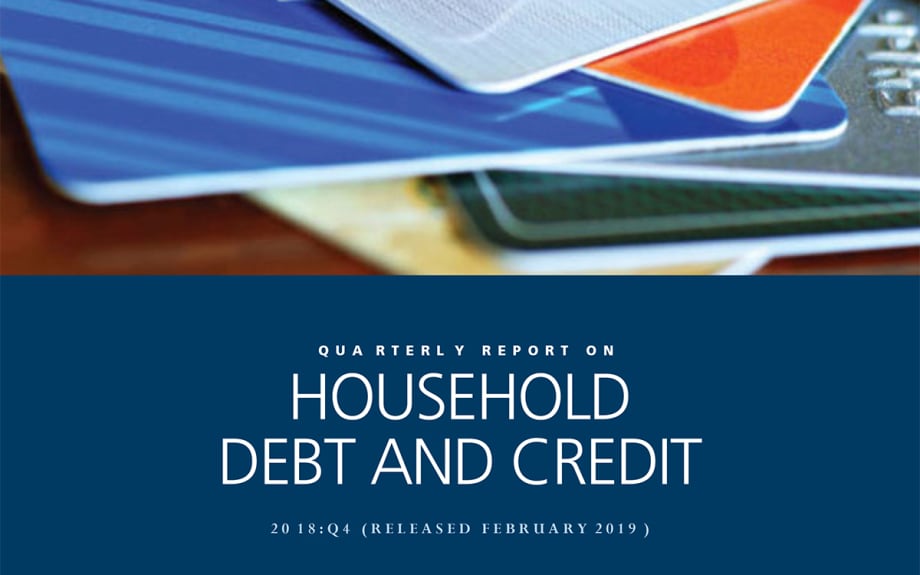
The Federal Reserve Bank of New York’s Q4 consumer debt report reflects historic growth and worrisome trends for the U.S. auto finance market.
Photo courtesy Federal Reserve Bank of New York
NEW YORK — The Federal Reserve Bank of New York’s Center for Microeconomic Data's “Quarterly Report on Household Debt and Credit” shows continued growth for the auto finance market amid concerns over increased lending to car buyers in the subprime credit tiers and an increasingly high 90-day delinquency rate.
Analysts said the aggregate U.S. household debt balance grew to $13.54 trillion in the fourth quarter of 2018. That’s a 0.2% increase from Q3 and 6.9% more than consumers owed when the Fed’s chart hit its last peak of $12.68 trillion in Q3 2008. About 195,000 U.S. consumers filed for bankruptcy in Q4, down from 200,000 in Q3. Aggregate credit card limits rose 1.5% for a 24th consecutive quarterly increase.
Auto originations totaled $144 billion in Q4 and $584 billion for the year, making 2018 auto finance’s biggest year since the Fed began tracking the metric 19 years ago. New mortgages, including refinanced mortgages, totaled $401 billion for the quarter, falling to a nearly four-year low.
Analysts noted that a “substantial” share (31%) of new auto loans were extended to borrowers with credit scores under 660 compared with only 10% of home loans. Also worrisome is the 90-day delinquency rate, which now accounts for 7 million U.S. car buyers.
“As of Dec. 31, 4.7% of outstanding debt was in some stage of delinquency, unchanged from the third quarter,” the report states, in part. “Of the $630 billion of debt that is delinquent, $416 billion is seriously delinquent (at least 90 days late or ‘severely derogatory’). The flow into 90-plus day delinquency for credit card balances has been rising since 2017, while the flow into 90-plus day delinquency for auto loan balances has been slowly trending upward since 2012.”
To read the complete report, click here.
Originally posted on F&I and Showroom
More Industry

First-Half Dealership Deals Up
Buy-sell activity shows that acquirers are looking for value and scale as many retailers seek to leave an increasingly competitive and complex market, Kerrigan Advisors reports.
Read More →
Kia Closes Out Summer With a Bang
Its U.S. subsidiary broke multiple records in August, in part due to a surge of demand for hybrids models.
Read More →
Indiana Dealership Changes Hands
A 30-year-old Ford dealership in Indiana has a new owner and will soon be undergoing renovations to meet manufacturer requirements.
Read More →
Texas Dealership No Longer in the Family
The Ford store, a longtime cornerstone of the Houston market, is now part of one of the fastest-growing U.S. auto groups.
Read More →
Genesis Grows California Presence
The Cardinale Automotive Group opened its third Genesis rooftop in the Golden State, Genesis of San Bruno, a stand-alone dealership serving the San Francisco Bay Area.
Read More →
August Auto Sales a Mixed Bag
An early forecast shows strong business despite consumer hurdles, and hybrids are a big piece of their affordability coping strategy.
Read More →
EV Market Humming Along
July sales show steady growth as the segment stabilizes from last year’s artificial surge following pullback of federal support.
Read More →
Auto Loan Delinquency Rates Stabilize
Auto loans are a main driver of nonmortgage consumer debt, but delinquency rates stabilized in the second quarter across all credit risk tiers.
Read More →
EV Sales Recover in Q2
The EV sales roller coaster continues as numbers show improvement, but industry experts predict a year-over-year third-quarter decline and fourth-quarter jump.
Read More →
The Cheapest Hybrids to Fuel
The powertrain is increasing in popularity, in no small part due to its fuel economy. A new report lists the most efficient hybrids on the market.
Read More →