


U.S. Auto Sales Still Below Prepandemic Levels
Mobility Global industry observers don’t expect the market to return to the higher volumes that became routine before Covid but to stay well below its potential.

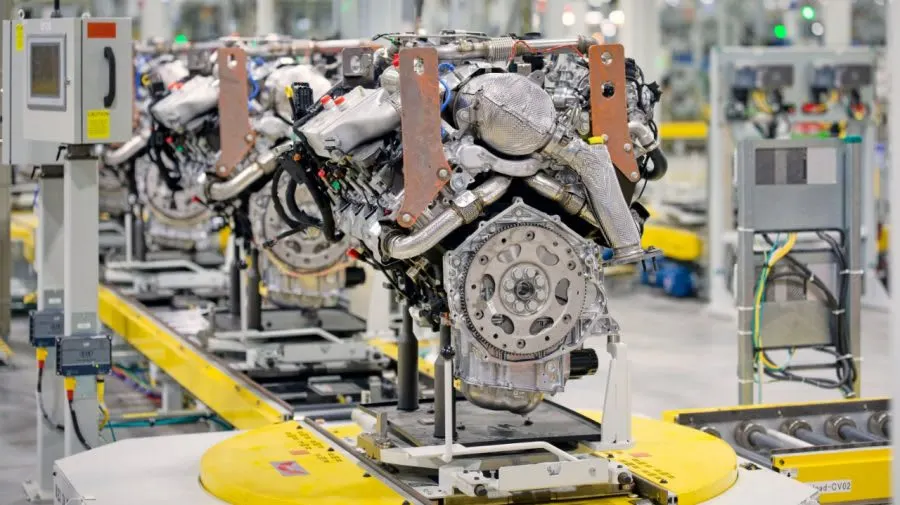
A diesel engine at a General Motors factory in Ohio. Mobility Global analysts see auto production concentrating in three regions: North America, Asia and Europe.
General Motors
Given persistent consumer affordability challenges, one forecaster doesn’t see the auto industry returning to prepandemic vehicle sales volume, at least not for the rest of the decade.
A forecast by auto data provider Mobility Global, formerly S&P Global Mobility, foresees 16.1 million units in light-vehicle sales in the U.S. by the end of the year and moving up to just 16.4 million by 2029.
The expected upward momentum would be far short of the 17 million units or more in annual sales before the Covid pandemic.
"Obviously, there is something constraining the market from those 17-million-unit thresholds that we routinely hit back in, say, 2016, 2017, 2018, 2019,” said Mobility Global Associate Director for Americas Demand Forecasting Peter Nagle.
The company said the U.S. auto market has been depressed since the global event, partly due to supply shortages. But it sees the inability to return to the sales volume seen in the years before the pandemic as an affordability issue.
"We don't see the U.S. returning to pre-pandemic levels of volumes," Nagle said.
Though U.S. regulatory and incentives changes over the past year have resulted in automaker pivots away from previously ambitious electric-vehicle lineup plans, Mobility Global sees fully electric vehicle production exceeding a million units in North America again next year and hybrid vehicle production taking off in a big way.
The company projects North American hybrid assembly will surpass three million units next year, up a dramatic 25%, and that almost a third of light vehicles built on the continent will be hybrids by 2030.
Mobility Global forecasters also envision more regionalization in auto production in a retreat from globalization as Asia, North America and Europe become the world’s “regional islands.”
“…automakers will increasingly have to build where they sell and design for the regions they serve,” said company Director of Research and Analysis Joe Langley. "The difficult part is doing that while costs continue to rise.”
More Industry

The Powertrain Shift
Electric-vehicle owners are backpedaling, according to new data, with product availability driving many to shift back to gas-powered engines.
Read More →
Achromatic Autos
The shades that dominate the U.S. car market don’t call attention to themselves, though grayscale may have plateaued after a 30-year upswing, research shows.
Read More →
Used-Vehicle Affordability Worsens
Listing prices in August defied seasonal trends, rising above $27,000 for the second time this year.
Read More →
First-Half Dealership Deals Up
Buy-sell activity shows that acquirers are looking for value and scale as many retailers seek to leave an increasingly competitive and complex market, Kerrigan Advisors reports.
Read More →
Kia Closes Out Summer With a Bang
Its U.S. subsidiary broke multiple records in August, in part due to a surge of demand for hybrids models.
Read More →
Indiana Dealership Changes Hands
A 30-year-old Ford dealership in Indiana has a new owner and will soon be undergoing renovations to meet manufacturer requirements.
Read More →
Texas Dealership No Longer in the Family
The Ford store, a longtime cornerstone of the Houston market, is now part of one of the fastest-growing U.S. auto groups.
Read More →
Genesis Grows California Presence
The Cardinale Automotive Group opened its third Genesis rooftop in the Golden State, Genesis of San Bruno, a stand-alone dealership serving the San Francisco Bay Area.
Read More →
August Auto Sales a Mixed Bag
An early forecast shows strong business despite consumer hurdles, and hybrids are a big piece of their affordability coping strategy.
Read More →
EV Market Humming Along
July sales show steady growth as the segment stabilizes from last year’s artificial surge following pullback of federal support.
Read More →