


Waymo Rolls Out Self-Driving Taxis
Waymo has set a new standard for driverless-vehicle proponents and ride-hailing providers by launching Waymo One, a revenue-generating autonomous transportation service.

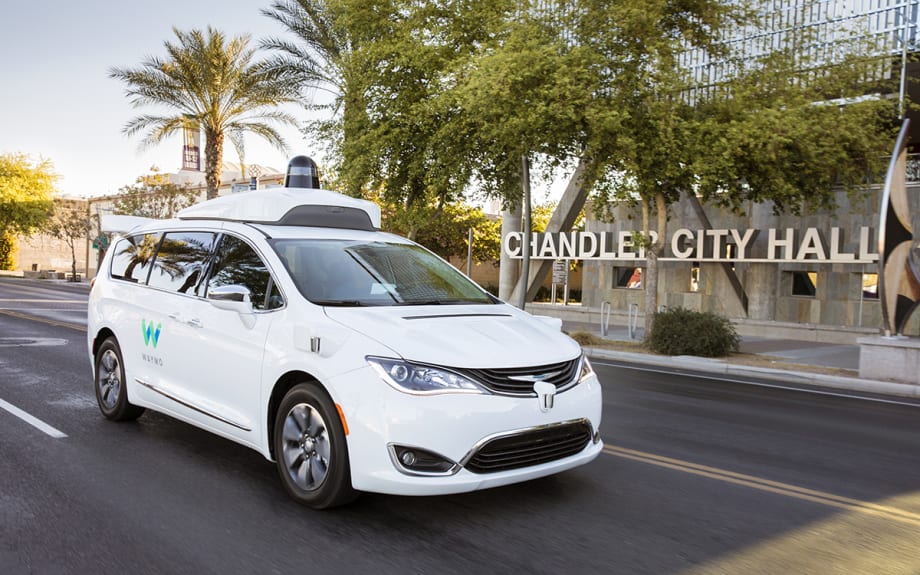
Self-driving, revenue-generating taxis have officially hit the streets of Chandler, Ariz., and other Phoenix-area cities.
Photo courtesy Waymo
PHOENIX — Wednesday marks the official debut of Waymo One, a new taxi service launched by Alphabet Inc., the parent company of Google. A group of 400-plus Phoenix-area early adopters will have 24-hour access to an unknown number of Waymo’s 600-unit fleet of Chrysler Pacifica Hybrids through a proprietary smartphone app.
Much like ride-hailing leaders Uber and Lyft, Waymo’s app allows users to store their credit card information, check availability and price, and contact the service. Unlike its competitors, Waymo’s vehicles navigate in “fully” autonomous mode — for the moment, every unit will be accompanied by a human driver tasked with intervening in emergencies.
Waymo units have been tested on public roads throughout the U.S., tallying more than 10 million miles, many of them in the Arizona cities of Chandler, Gilbert, Mesa, and Tempe.
In March, a Tempe woman was struck and killed by an Uber-operated SUV while walking her bicycle across the street at night. The Uber unit failed to stop and the vehicle’s “safety driver” failed to react in time. Despite that incident and others, Arizona remains a friendly regulatory environment for autonomous vehicle testers. No federal guidance on the technology appears to be immediately forthcoming.
“Over time, we hope to make Waymo One available to even more members of the public as we add vehicles and drive in more places,” wrote CEO John Krafcik in a blog entry Wednesday. “Self-driving technology is new to many, so we’re proceeding carefully with the comfort and convenience of our riders in mind.”
Originally posted on Auto Dealer Today
More Industry
Badger State Dealership Gets New Owner
The longtime southern Wisconsin store moved from one area auto group to another, keeping the business in Dairyland.
Read More →
The Cycle of Negative Equity
Third-quarter data shows consumers still rolling over debt and stretching loan terms, raising their risk of remaining underwater.
Read More →
Charger Network Growth Slows
Despite a projected increase in public EV chargers in 2026, charging infrastructure remains a top concern for consumers as the gap between the most and least EV-friendly places remains substantial.
Read More →
Lenders, Consumers Take on More Auto Loan Risk
September records loosened credit access the most in over a decade as buyers took advantage of the conditions to afford trading, though loan applications fell.
Read More →
Next-Gen Hybrids in Sight
Dealerships can expect to see revamped hybrids from Honda next year as the company rolls out a new system and model lineup.
Read More →
Gem State Stores Change Hands
A larger auto group founded in the industry’s early years sold two franchises to a neighbor group that's on a growth spurt.
Read More →
Charging In Motion
Honda has been researching wireless in-motion charging for electric vehicles since 2025, and new technology developments have put it a step closer to a final product.
Read More →
Twin Cities Stores Sell
Minnesota-based Walser Automotive Group made what it called the most significant acquisition in its history with a three-rooftop deal in Minneapolis.
Read More →
U.S. Auto Sales Still Below Prepandemic Levels
Mobility Global industry observers don’t expect the market to return to the higher volumes that became routine before Covid but to stay well below its potential.
Read More →
The Powertrain Shift
Electric-vehicle owners are backpedaling, according to new data, with product availability driving many to shift back to gas-powered engines.
Read More →