


A Time-Tested Vision
Businessman Steward Holman built his automotive dream on a solid frame that transcends every industry age.
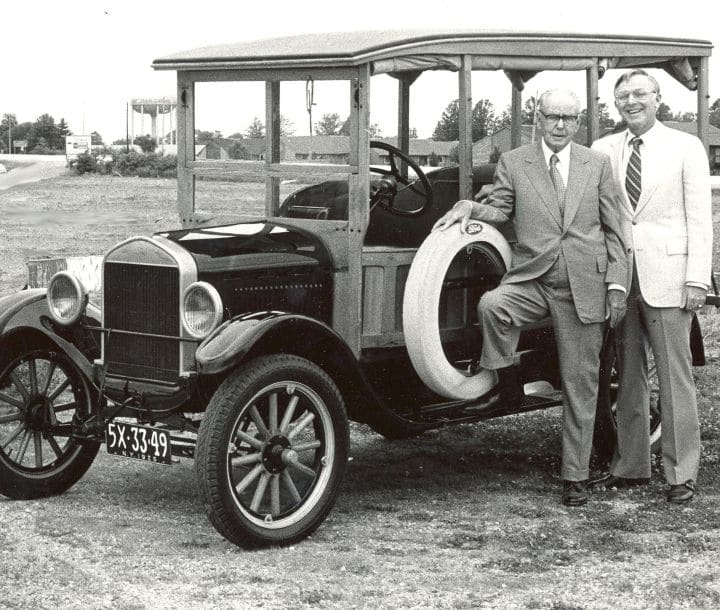
Holman founder Steward Holman, left, with his son Joseph in front of a Model T in this circa 1970s photo. Joseph took over company leadership in 1982 when Steward died.
Holman
It was the middle of the roaring ‘20s, but Steward Holman hadn’t let the headiness of the era go to his head.
When he opened a Ford dealership in August 1924 with a $13,500 loan from Pennsylvania businessman Charles Rice, he not only included Rice in the store’s name but placed him first: Rice & Holman Ford.
More than that, the Merchantville, N.J., store, well-positioned to take advantage of the growing car craze due to its proximity to bustling Philadelphia, kept that name for decades, many years after that loan was paid back in full.
Holman, as his granddaughter, Mindy Holman says, just wanted to start a family business. And that he did, though he may not have envisioned how far his vision would take the enterprise.
A Career Lab
What is now called simply Holman, in what seems a validation of its founder’s commitment to doing business the right way, the privately held company is now one of the biggest auto groups in the U.S. and does much more than sell and service cars.
The inheritors of Steward Holman’s legacy say the group’s growth and stature in the industry trace back to his consistent focus on valuing and developing its employees, a philosophy the company holds to today.
“I am so grateful to our people, who are responsible not only for Holman's success but also for fostering an exceptional culture that continues to positively impact the communities in which we live and work,” Mindy Holman, board chairman since 2004, said in a statement.
“As we grow, one of the major focus areas for us is will this help our employees, will it help career growth for them, will it help in their ability to move up in the organization in any way?” said Senior Vice President, Retail Central Services and OEM Operations Petter Witt.
He left a promising career at BMW North America to join Holman in 2017 because “the culture is incredible,” he said. There he oversees multiple groups and works on automaker business development.
Because Holman has diversified to an unusual degree for an auto group to become an international automotive services conglomerate, the opportunities for its employees are myriad. In addition to operating nearly 60 auto dealerships among 34 brands, it provides leasing and fleet management services; vehicle upfitting; insurance services; commercial-vehicle equipment; and power train solutions for OEM parts and logistics. The wide-scope expansion came gradually but intentionally.
Building Blocks
Not long after Steward Holman opened the original dealership in the vibrant ‘20s, it grew perhaps more than he’d imagined, especially since the Great Depression set in five years later. Regardless of the destitution that spread across the country and the rest of the world, the store became one of the biggest Ford franchises in the U.S.
At the end of the devastating downturn in 1939, Steward, confident in his business judgment to step outside of retail, stretched his horizons into manufacturing engines and transmissions. He built that business into a distributorship after World War II in 1946. The following year, the company further widened its roadmap by opening a dealership in Florida, where Steward owned a second home. Then, from a corner of the New Jersey dealership, it expanded into fleet management in what became the biggest part of the company today, with more than two million in assets managed.
It was around this period that Steward was filmed speaking to businessmen about his entrepreneurial successes.
“He says we are so successful because we focus on our employees, their training, providing clear objectives, and out-manage the competition,” says Witt, who’s watched the black-and-white footage. “That’s our philosophy today, as well … There’s such a red thread there.”
From the post-war period through the 1950s and ‘60s, the company focused on growing its retail and commercial arms before adding vocational vehicle upfitting for its fleet customers in 1982, the year Steward died and his son, Joseph, took over the business. The move helped it expand its fleet division into Canada in 1989, to Mexico in 1993, the United Kingdom in 2011 and Germany in 2013 to make it one of the largest fleet management providers in the world.
Toward the end of this time of expansion, Holman acquired Auto Truck Group to increase its upfitting capacity. And to further service its fleet-management customers, the company established an insurance services division in 2016, the same year it acquired Kuni Automotive group in the Western U.S. to become a national auto retail organization.
But it still wasn’t done adding service divisions. It started making commercial vehicle racks and equipment in 2017 and even launched an auto-focused venture capital funding division in 2019, a foray Witt says helps Holman stay at the forefront of industry innovation. It even uses in its business the technology of many of the startups it funds.
“That’s what makes our company so unique. It’s all auto related but is truly diversified,” Witt said of the exponential divisional growth. “It really tells you that small ideas can turn into these huge opportunities.”
None of the diversification means Holman has put its original enterprise on the back burner, though. Last year, it almost doubled its retail footprint with the acquisition of 28-rooftop Leith Automotive Group in North Carolina.
Human Investments
Regardless of how and how much Holman expands, its leadership keeps their eyes on the two guiding principles that Steward Holman set for his new company in the ‘20s: the employee and the customer. It can’t service the latter without building the former to be the best it can be, Witt says.
“We try to put our employees in positions to win, an environment that they enjoy. We provide the tools that they need, provide the training and support for them to continue to better themselves and the business, making sure we provide opportunities for them to grow their careers,” he says.
That includes mentoring and leadership-development, though it starts with a “vigorous” employment process to ensure the company hires people who share Holman’s foundational philosophies, “good people with the mindset that we treat everybody as we want to be treated ourselves,” Witt says.
It’s already working to integrate its latest acquisitions in North Carolina to help them become part of the Holman culture as it stays open for any future growth opportunities. When it adds dealerships, it will focus on growing its footprint in the regions where it currently has stores so it can support current employees’ career growth, Witt said, referring to Holman’s “hub” expansion concept.
Zooming out from there to the customers that Holman employees serve, the company has its sights set on further tailoring the shopping experience for a consumer transformed dramatically from the early days of the automobile when Steward opened his first store.
It’s crucial that automotive retail adapt to consumers’ shifting expectations, Witt said. “Capitalize on technology to make it easier and better for consumers,” for one. “We continue to double down on that.
Holman wants to present itself as a brand that gets the customer and is working on streamlining and solidifying the brand experience for them. “Imagine there’s no logos on the building. You don’t know the brand you’re shopping, who owns the dealership … We think it’s important that you should recognize you’re in a Holman store simply by the experience you’re receiving. You want the experience to be so good and so recognizable that you say, ‘I guarantee this is a Holman dealership.”
Holman will utilize innovation and plain common sense to continuously improve and make more consistent customers’ experience in its stores and ensure employees know the customers as individuals.
The belief is that such attention to detail will put Holman in good stead despite the challenges of keeping up in a fast-changing industry, from affordability concerns to the electric-vehicle picture, which has been evolving in a nonlinear fashion that’s hard to predict and therefore prepare for.
Putting the employee and then the customer at the top of the priority list is a timeless principle other dealer groups would be wise to replicate.
Thinking of Steward’s wise outlook in the industry’s infancy, Witt says, “gives you the sense that really good people can win.”
Hannah Mitchell is executive editor of F&I and Showroom. A former daily newspaper journalist, she honed her craft covering politics, business and more for publications that included the Charlotte Observer and the Orange County (Calif.) Business Journal. She holds a master’s degree in journalism from Columbia University, and her first car was a hand-me-down Chevrolet Nova.
Originally posted on F&I and Showroom
More Industry

Charger Network Growth Slows
Despite a projected increase in public EV chargers in 2026, charging infrastructure remains a top concern for consumers as the gap between the most and least EV-friendly places remains substantial.
Read More →
Lenders, Consumers Take on More Auto Loan Risk
September records loosened credit access the most in over a decade as buyers took advantage of the conditions to afford trading, though loan applications fell.
Read More →
Next-Gen Hybrids in Sight
Dealerships can expect to see revamped hybrids from Honda next year as the company rolls out a new system and model lineup.
Read More →
Gem State Stores Change Hands
A larger auto group founded in the industry’s early years sold two franchises to a neighbor group that's on a growth spurt.
Read More →
Charging In Motion
Honda has been researching wireless in-motion charging for electric vehicles since 2025, and new technology developments have put it a step closer to a final product.
Read More →
Twin Cities Stores Sell
Minnesota-based Walser Automotive Group made what it called the most significant acquisition in its history with a three-rooftop deal in Minneapolis.
Read More →
U.S. Auto Sales Still Below Prepandemic Levels
Mobility Global industry observers don’t expect the market to return to the higher volumes that became routine before Covid but to stay well below its potential.
Read More →
The Powertrain Shift
Electric-vehicle owners are backpedaling, according to new data, with product availability driving many to shift back to gas-powered engines.
Read More →
Achromatic Autos
The shades that dominate the U.S. car market don’t call attention to themselves, though grayscale may have plateaued after a 30-year upswing, research shows.
Read More →
Used-Vehicle Affordability Worsens
Listing prices in August defied seasonal trends, rising above $27,000 for the second time this year.
Read More →