


Auto Dealer Service Departments Trying to Navigate Parts and Staffing Challenges, J.D. Power Finds
The combination of vehicle owners needing service more often due to accumulating mileage at pre-pandemic levels along with the disruption of the auto parts supply chain and significant staffing shortages is causing auto dealership service departments to navigate unique capacity challenges.

The combination of vehicle owners needing service more often due to accumulating mileage at pre-pandemic levels along with the disruption of the auto parts supply chain and significant staffing shortages is causing auto dealership service departments to navigate unique capacity challenges.
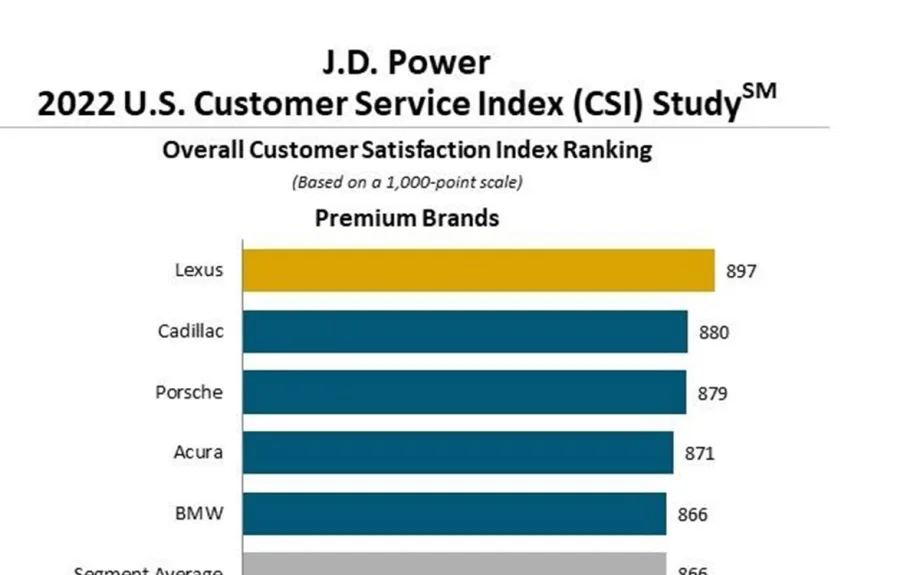
The combination of vehicle owners needing service more often due to accumulating mileage at pre-pandemic levels along with the disruption of the auto parts supply chain and significant staffing shortages is causing auto dealership service departments to navigate unique capacity challenges, according to the J.D. Power 2022 U.S. Customer Service Index (CSI) Study, SM released today.
Wait times to schedule service appointments for one- to three-year-old vehicles have increased by nearly one full day among owners of premium and mass market vehicles (to 4.5 and 4.3 days, respectively). Overall customer service satisfaction is 848 (on a 1,000-point scale).
“Dealer service departments are in a pivotal position to improve customer satisfaction and provide greater customer convenience, even though many challenges—including the parts supply chain disruption and the availability of new-vehicle loaners—are out of their control,” said Chris Sutton, vice president of automotive retail at J.D. Power. “Proactive communication with customers is one solution for dealerships to mitigate a disruptively tough situation. Simply implementing text or email alerts can greatly improve customer satisfaction. Additionally, letting customers know what is happening at each step along the way, including why it is taking longer to book an appointment or providing any updates in parts delays, can help improve satisfaction.”
The study, now in its 42nd year, has been redesigned this year to include emerging features such as valet service, remote vehicle servicing and online/smartphone app payment options to gauge the effect these processes have on the service experience. The study measures satisfaction with service at franchised dealer or aftermarket service facilities for maintenance or repair work among owners and lessees of one- to three-year-old vehicles. It also provides a numerical index ranking of the highest-performing automotive brands sold in the United States, which is based on the combined scores of five measures that comprise the vehicle owner service experience. These measures are (in order of importance): service quality (32%); service advisor (19%); vehicle pick-up (19%); service facility (15%); and service initiation (15%).
Following are key findings of the 2022 study:
Customers trust dealer service departments: The redesigned study also measures factors relating to trust between a customer and the dealership. On a rating scale of 1 to 7 points, the most important trust attribute is, “I trust the dealership to perform complex repairs on my vehicle,” with an average rating of 6.16. However, the second-most important attribute, “Takes responsibility when a mistake is made and resolves it effectively,” has the lowest average rating (5.91).
Your vehicle is ready: The service department sending simple text messages to remind of upcoming appointment dates or to provide a status for in-process work are preferred by 42% of customers. Additionally, owners today gravitate toward other technology channels to communicate with the service department, including making appointments online (27%) and via mobile app (7%), and paying online (17%). “Dealers who meet customers on their preferred communication channels are gaining an advantage,” Sutton said. “Service departments need to jump on the technology train now or risk being left behind.”
Seeing is believing: New to the redesigned study is a metric that measures satisfaction when the service department provides a recommended photo or video of repair work with the customer after a multi-point inspection and before needed work is approved. This additional communication feature is having a positive effect on business and trust, as well as on customer satisfaction. When customers receive a photo or video communication regarding their needed maintenance work, they are three times more likely to have advisor-recommended work done. Additionally, on a 7-point rating scale, dealerships are building a higher level of trust with customers (.39 point higher) than are their counterparts who do not provide a photo or video.
If you go to them, satisfaction will improve: New to the study in 2022 is a measurement of satisfaction among customers who select to have their vehicle serviced either by valet (when a dealership picks up the vehicle) or mobile (when the dealership sends a technician to the customer’s location). Overall customer satisfaction among owners using valet or mobile service is 866 compared to 847 among those who had an in-person dealership visit.
Next frontier is battery electric vehicle (BEV) service experience: With BEV sales expected to increase in the coming years, dealers have a significant service quality satisfaction gap to close. Overall service satisfaction among BEV owners (784) is 68 points lower than among owners of gas- or diesel-powered vehicles (852). Additionally, the average number of service visits a BEV owner makes in a year is 1.9 compared with 2.4 among owners of gas- and diesel-powered vehicles. “BEV service is the next frontier for dealerships,” Sutton said. “The automotive industry has to get ready now and get the service experience right with BEV owners or they risk losing them to aftermarket service providers. This includes fully understanding BEV customer pain points like range anxiety, unique maintenance requirements and support for related services such as availability of charging stations.”
Originally posted on Agent Entrepreneur
More Industry

Charger Network Growth Slows
Despite a projected increase in public EV chargers in 2026, charging infrastructure remains a top concern for consumers as the gap between the most and least EV-friendly places remains substantial.
Read More →
Lenders, Consumers Take on More Auto Loan Risk
September records loosened credit access the most in over a decade as buyers took advantage of the conditions to afford trading, though loan applications fell.
Read More →
Next-Gen Hybrids in Sight
Dealerships can expect to see revamped hybrids from Honda next year as the company rolls out a new system and model lineup.
Read More →
Gem State Stores Change Hands
A larger auto group founded in the industry’s early years sold two franchises to a neighbor group that's on a growth spurt.
Read More →
Charging In Motion
Honda has been researching wireless in-motion charging for electric vehicles since 2025, and new technology developments have put it a step closer to a final product.
Read More →
Twin Cities Stores Sell
Minnesota-based Walser Automotive Group made what it called the most significant acquisition in its history with a three-rooftop deal in Minneapolis.
Read More →
U.S. Auto Sales Still Below Prepandemic Levels
Mobility Global industry observers don’t expect the market to return to the higher volumes that became routine before Covid but to stay well below its potential.
Read More →
The Powertrain Shift
Electric-vehicle owners are backpedaling, according to new data, with product availability driving many to shift back to gas-powered engines.
Read More →
Achromatic Autos
The shades that dominate the U.S. car market don’t call attention to themselves, though grayscale may have plateaued after a 30-year upswing, research shows.
Read More →
Used-Vehicle Affordability Worsens
Listing prices in August defied seasonal trends, rising above $27,000 for the second time this year.
Read More →