
Wholesale Prices, Week Ending July 22

 MENU
MENU SEARCH
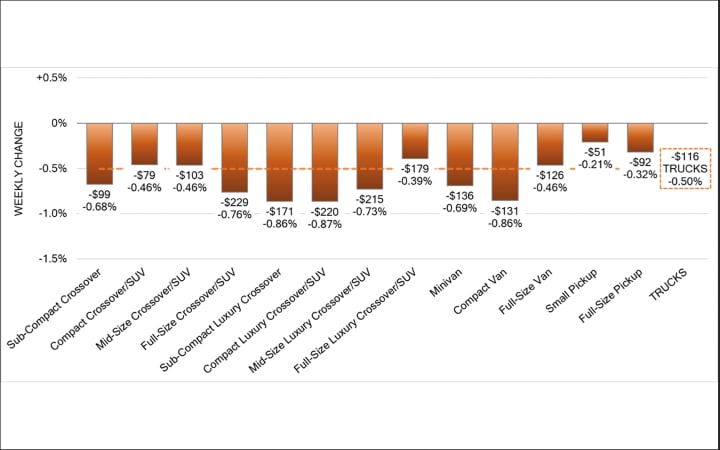
The volume-weighted, overall truck segment decreased 0.50%, smaller than the prior week’s decrease of 0.70%, though all 13 truck segments fell.
The market continues to decline, and despite the overall drop last week being less than the week prior, the level of weekly declines continues to exceed what's typical for this time of year based on prepandemic trends. Many auctions across the country saw increases in conversion rates and the number of units offered for sale, but the condition of units is a challenge for buyers with low CRs and high mileage.
This Week Last Week 2017-2019 Average (Same Week)
Car segments -0.59% -0.77% -0.29%
Truck & SUV segments -0.50% -0.70% -0.22%
Market -0.53% -0.73% -0.25%
On a volume-weighted basis, the overall car segment decreased 0.59%, following a 0.77% decrease the previous week.
The 0- to 2-year-old segments were also down, but only by 0.46%; 8- to 16-year-old cars declined 0.56%.
All nine car segments decreased.
Compact (-0.94%) and full-size (-0.90%) segments had the largest declines, both with increases in depreciation from the prior week of 0.77% and 0.86%, respectively.
The luxury segments had smaller depreciation; for example, the prestige segment was down 0.40%, compared with the prior week’s depreciation of 0.71%.
The volume-weighted, overall truck segment decreased 0.50%, smaller than the prior week’s decrease of 0.70%.
The 0- to 2-year-old segments reported a similar decline last week (-0.50%), but the 8- to 16-year-olds declined less, down 0.44%.
All 13 truck segments reported a decrease.
Compact luxury crossover/SUV (-0.87%), sub-compact luxury crossover/SUV (-0.96%), and compact vn (-0.86%) reported the largest truck segment declines.
The full-size pickup (-0.32%) segment is declining, but the rate of decline continues to be lower than the overall market average. Last week’s decline was the seventh consecutive week, for an average weekly depreciation rate of 0.32%.
The graphic below looks at trends in wholesale prices of 2- to 6-year-old vehicles, indexed to the first week of the year. The index is computed keeping the average age of the mix constant to identify market movements.
Used-retail prices are more accessible than in past years due to the proliferation of no-haggle pricing. Transparent pricing upfront makes the car-buying process more enjoyable for customers and allows Black Book to accurately measure retail market trends. At the onset of the pandemic, in CY2020, used-retail prices increased slightly, following typical seasonal patterns, then began dropping in April, finally hitting a low point in the late spring months. By late summer of CY2020, they increased as supply of new-vehicle inventory started to become scarce, but retail demand slowed at the end of CY2020, resulting in declining retail asking prices for the last several weeks of the year. When CY2021 kicked off, demand rebounded while retail prices lagged slightly behind wholesale prices; March 2021 started the dramatic increases in used-retail prices, fueled by stimulus payments, tax season and shortages of new inventory. During the third quarter, retail prices continued to rise at a slower rate but soon picked up again to start the fourth quarter, when prices steadily increased. As CY2021 came to an end, the retail listing price index closed 36% above where the year began. The index remained relatively stagnant through most of CY2022. In the fourth quarter of 2022, the Retail Listings Price Index started to decline, but drops weren't as steep as the wholesale price index.
This analysis is based on approximately two million vehicles listed for sale on U.S. dealer lots. The graphic below looks at 2- to 6-year-old vehicles. The index is computed keeping the average age of the mix constant to identify market movements.
The Used Retail Active Listing Volume Index reverted back to one at the start of the year. Currently, it sits at 1.01 points.
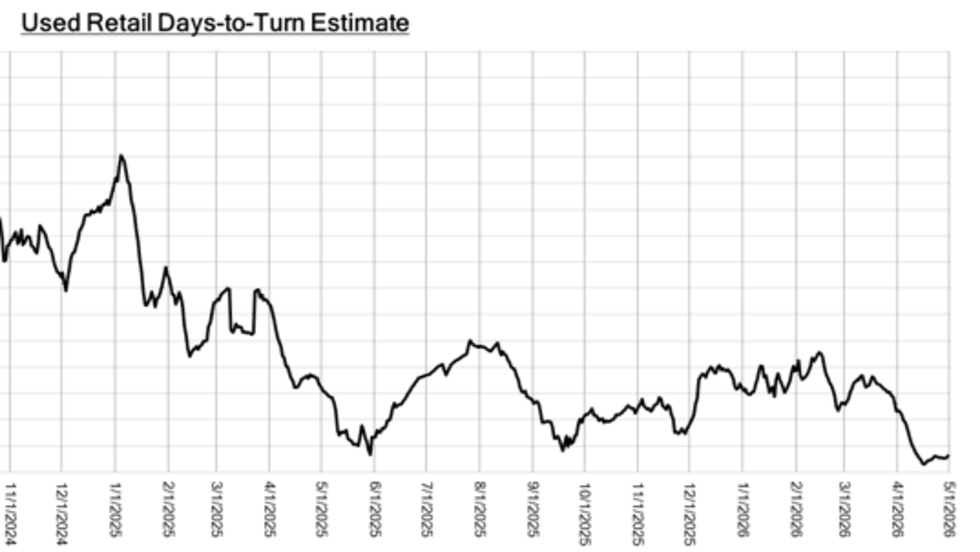
The used retail days-to-turn estimate is currently around 51.
In the auction lanes, we're still seeing a lot of no-sale and If bids, but surprisingly, conversion rates have moved up slightly over the last few weeks as sellers adjust their floors. As we see new inventory levels improving, the newer used units at auction are seeing some heavier depreciation, particularly with the truck and SUV segments.
The Black Book team of analysts will keep their eyes on the market, watching for developing trends and insights.
The estimated average weekly sales rate continued to improve, increasing to 48% last week.
Originally posted on Auto Dealer Today
Conversion rates were flat last week at 63%, Black Book analysts calculated, as low-mileage and almost-near units outpaced the overall market.
Read More →
Trade relations between the European Union and the U.S. are at risk, causing the European Automobile Manufacturers Association to push lawmakers to make a decision.
Read More →
Understanding the risks and benefits of retail accounting and Super CFCs can help you better present options to your dealer partners.
Read More →
China easily reigns in the segment, but European countries’ adoption rates are growing. The U.S., probably due to market size, has the second biggest EV fleet.
Read More →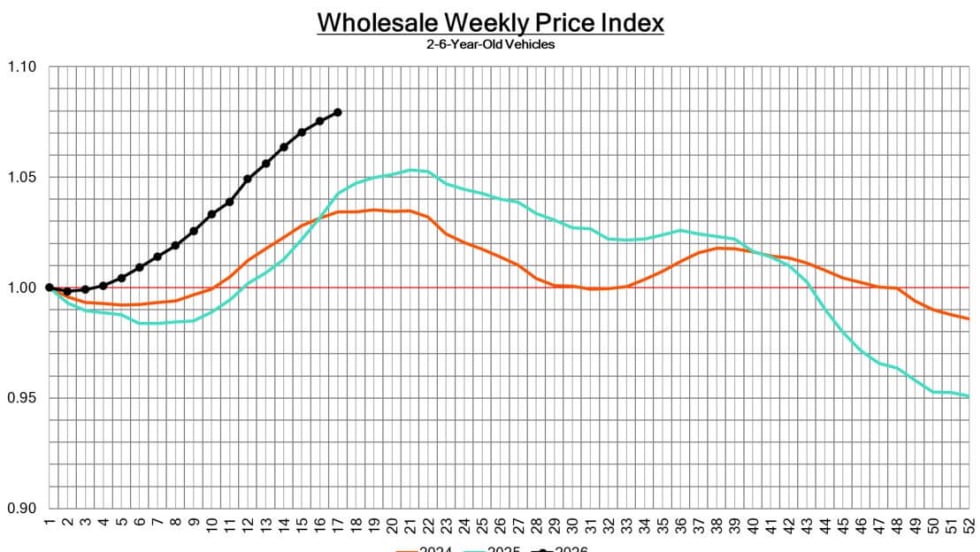
The full-size pickup segment, which has been dominant in the U.S., ended 11 consecutive weeks of gains with a slight dip last week.
Read More →
Wholesale auto conversion rates dropped slightly as auction buyers proved picky last week, analysts observed.
Read More →
Fast charging of electric vehicles provides a solution for range anxiety, but it also poses a risk to battery cycle life due to increased temperatures, according to an EV supply chain data provider.
Read More →
Expanding Midwest automotive group picks up three stores as part of the robust transaction activity early this year.
Read More →
Cox Automotive data shows Americans doubled down on big-is-better despite price increases. Slightly higher incentives helped fuel the demand.
Read More →
The automaker says its movement of some electric-vehicle work to the S.C. factory is part of a more tailored product focus. It also plans to add a new hybrid model to the plant’s itinerary.
Read More →