


New Test Ranks EVs' Charge Times
Edmunds says proprietary data, Level 3 measurements pinpoint individual models’ fast-charging speeds.

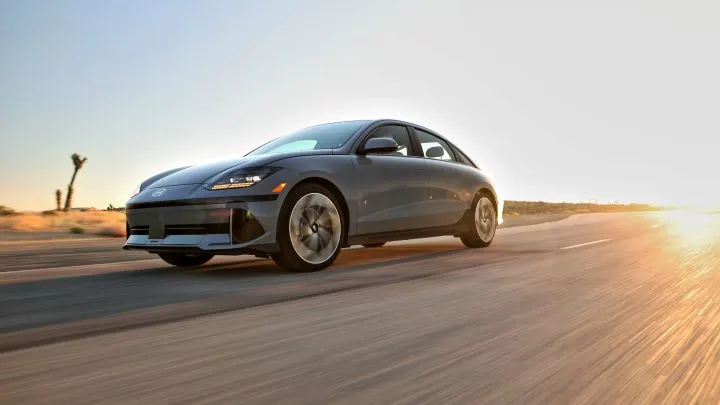
Edmunds says the Hyundai Ioniq 6 tops tested models with an average speed of 868 miles per charging hour, or the equivalent of 100 miles of charge in just under seven minutes.
IMAGE: Hyundai
Edmunds unveiled an electric-vehicle fast-charging test it says shows how quickly an EV model charges.
Charging efficiency is one of a mix of factors prospective EV adopters consider when contemplating a switch from gas-powered models. Gassing up a car takes a fairly predictable amount of time, depending on whether one has to wait to pull up to a pump, but charging speed can vary widely, depending on the model. A recent S&P Global Mobility study found charge speed ranked second only to high price among consumers' reasons for opting out of EV purchases.
Edmunds claims its EV Charging Test independently determines the amount of time it takes an individual model to charge via a fast-charger. It says the evaluation combines Level 3 charging measurements – Level 3 being the fastest charging type – with data from its own efficiency test to arrive at “a new industry standard for electric vehicle charging speeds.”
The company said it tested more than 40 EV models in the inaugural round to arrive at a ranking based on charging speed, putting the Hyundai Ioniq 6 sedan at the top with an average speed of 868 miles per charging hour, or the equivalent of 100 miles of charge in just under seven minutes. At the bottom of the list is the Chevrolet Bolt EUV at 172 miles per charging hour.
Along with the Ioniq 6, top charging performers are the Kia EV6 crossover sports-utility vehicle and the Porsche Taycan sports car, Edmunds said, pointing out that optimum charging efficiency isn’t reserved to luxury models.
Edmunds says the test can hold vehicle makers accountable about charging speeds.
"For too long, automakers have been able to pick and choose, without scrutiny, charging data in order to highlight the best attributes of their vehicles," said Editor-in-Chief Alistair Weaver, who in a press release called the test “an industry benchmark that allows car shoppers to compare charging speeds based on real-world testing and empirical data."
Federal prosecutors are reportedly investigating whether Tesla exaggerated its models’ range between charges after an August Reuters report said the U.S. EV market leader overstated ranges in advertisements and vehicle range meters.
The Edmunds test’s miles per charging hour indicates average charging speeds when charging from 10% to 80%, also expressed as the average time needed to achieve 100 miles of charge. Also included in results are average charging power, peak charging power, charging losses and consumption.
Originally posted on Auto Dealer Today
More Industry

Charger Network Growth Slows
Despite a projected increase in public EV chargers in 2026, charging infrastructure remains a top concern for consumers as the gap between the most and least EV-friendly places remains substantial.
Read More →
Lenders, Consumers Take on More Auto Loan Risk
September records loosened credit access the most in over a decade as buyers took advantage of the conditions to afford trading, though loan applications fell.
Read More →
Next-Gen Hybrids in Sight
Dealerships can expect to see revamped hybrids from Honda next year as the company rolls out a new system and model lineup.
Read More →
Gem State Stores Change Hands
A larger auto group founded in the industry’s early years sold two franchises to a neighbor group that's on a growth spurt.
Read More →
Charging In Motion
Honda has been researching wireless in-motion charging for electric vehicles since 2025, and new technology developments have put it a step closer to a final product.
Read More →
Twin Cities Stores Sell
Minnesota-based Walser Automotive Group made what it called the most significant acquisition in its history with a three-rooftop deal in Minneapolis.
Read More →
U.S. Auto Sales Still Below Prepandemic Levels
Mobility Global industry observers don’t expect the market to return to the higher volumes that became routine before Covid but to stay well below its potential.
Read More →
The Powertrain Shift
Electric-vehicle owners are backpedaling, according to new data, with product availability driving many to shift back to gas-powered engines.
Read More →
Achromatic Autos
The shades that dominate the U.S. car market don’t call attention to themselves, though grayscale may have plateaued after a 30-year upswing, research shows.
Read More →
Used-Vehicle Affordability Worsens
Listing prices in August defied seasonal trends, rising above $27,000 for the second time this year.
Read More →